What Do Traffic Sign Colors Mean?
Published · Updated
How a standardized color-coding system promotes safety on our roadways
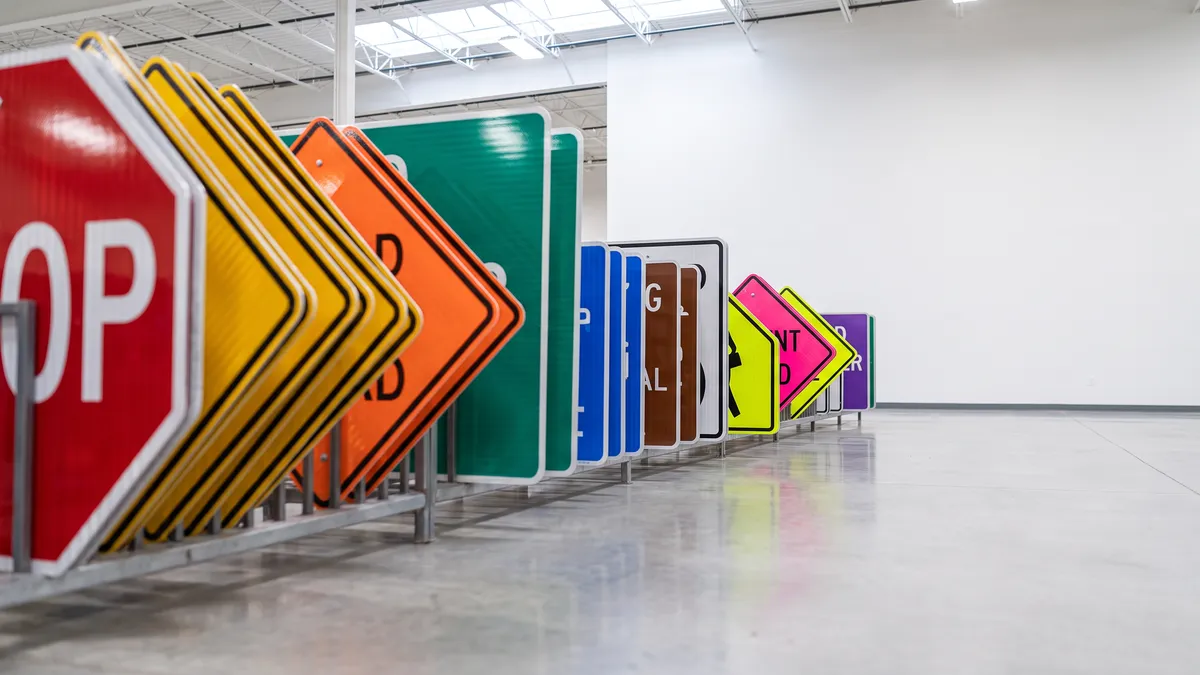
You’ve surely seen traffic signs of many colors along roadways—the green of Street Signs, the yellow of Warning Signs, the red of Stop Signs.
But why are those traffic signs the color that they are? Did you know that each color represents a standardized usage? Federal guidelines on traffic safety, the Manual on Uniform Traffic Control Devices (MUTCD), defines the design of compliant traffic signs that must be used on a public roadway. That determination is built from a set of underlying rules about sign color and connecting that specific color with a common understanding of what it means and is associated with.
There are two main reasons why color consistency matters. One, colors are typically easier to process at a glance. Two, using colors reduces the chances of misunderstanding what the sign is communicating. Take a quick look through the following reference chart and discover what each sign color typically means.
| Color | Meaning |
|---|---|
| Black | Regulation |
| Blue | Road-user services guidance, tourist information, and evacuation route |
| Brown | Recreational and cultural interest area guidance |
| Coral | Reserved for future designation |
| Fluorescent Pink | Incident management |
| Fluorescent Yellow-Green | Pedestrian warning, bicycle warning, playground warning, school bus warning, and school warning |
| Green | Indicated movements or actions permitted and direction guidance |
| Light Blue | Reserved for future designation |
| Orange | Temporary traffic control |
| Purple | Restricted to use only by vehicles with registered electronic toll collection (ETC) accounts |
| Red | Stop or prohibition |
| White | Regulation |
| Yellow | Warning |

Red Traffic Signs – Stop & Prohibition
Red is used in the traffic sign color-coding system to command authority. The color is used for the most essential regulatory signs that directly control the flow of traffic, such as Stop Signs, Yield Signs, Do Not Enter Signs, and Wrong Way Signs. Not only do most of these signs have a unique shape, they are also all primarily red in color. The shared color connects the common traffic flow control uses among the signs.
So where are these red traffic signs used? They are typically used at intersections of any configuration. Signs direct drivers to modify their behavior (full stop, yield, not entering a road) while assessing the conditions at the intersection. For instance, a four-way stop-sign-controlled intersection relies on drivers fully stopping and following the right-of-way rules that have long been established on roadways.
While the above signs are used to manage traffic flow, other red signs can communicate an action that should not be performed. No Parking Signs are the most representative example of prohibitive signs that are primarily red in color. Whether the sign has “No Parking” written in text or a symbol sign featuring the black letter “P” overlaid by a red circle/diagonal slash combination, the red color communicates that a certain action, in this case parking, is not allowed. This restriction may be unconditional and applicable at all times, or conditions can be added to allow parking in limited cases.
Yellow Traffic Signs – Warning & Hazards
The family of traffic signs that are yellow all have the same use of warning drivers of conditions farther down the roadway. Yellow communicates to proceed with a raised awareness that something about the road itself will change. That change could be an unexpected curve to the left (Curve Left), a stop sign being ahead (Stop Sign Ahead), or that a railroad crossing will soon appear (Railroad Crossing). There is some variation in their shape, but the majority of yellow traffic signs are diamond-shaped with text or a symbol. Signs are often supplemented with an informational placard mounted directly below on the same sign post.
An additional use of yellow traffic signs is warning drivers of hazards ahead. For instance, these signs are used when deer are more likely to appear over the defined number of miles (Deer Crossing + Mile Placard) or that a significant amount of loose gravel is on the road under construction (Loose Gravel).
White Traffic Signs – Rules & Regulations
The simple design of a white traffic sign with black text communicates matter-of-fact roadway information. When a Speed Limit Sign reads “30 MPH” or a One-Way Sign points toward the one-way road, the information contained on those signs clearly sets the rules of the road. There’s no real modification or variance to how drivers should interpret white traffic signs. In contrast to yellow traffic signs that communicate that a traffic flow change or potential hazard is ahead, white traffic signs establish how drivers should drive through roads: their speed, direction, and what rules to follow. Because of their essential information, there is a relatively small number of white traffic sign types used on roadways
Orange Traffic Signs – Construction & Temporary Conditions
When you see an orange sign, there are only two uses allowed by the MUTCD. They are specifically used for work zones and for temporary detours around construction areas. Thus, this family of signs are designed for what federal guidance calls “temporary traffic control” (TTC) use only, and must be covered when a project is paused or taken down when a project is completed. The bright orange material used to make these signs stands out in any type of weather and in any light condition, bright daylight or low light at nighttime. Additionally, there’s a strong association between these traffic signs and other work zone devices. The orange of these signs matches the orange of the Traffic Cones, Barricades, and Channelizing Walls also used in work zones.
Green Traffic Signs – Direction & Navigation
Traffic signs in a distinctive green are used for street names, exit signs, and other guidance that will lead you to your destination. So why use green for this set of signs? Navigational information on exits and Street Name Signs is important for wayfinding, but is generally secondary to regulatory information, such as stops, yields, and signals controlling overall traffic flow. Because of this, signs don’t need as much attention drawn to them, and a color like the standardized “traffic green” is easily spotted without being too visually loud to interfere with other roadside messaging.
Blue Traffic Signs – Services & Facilities
Signs that are blue have text, symbols, or a combination of both to communicate that important facilities are farther down the road. Some signs that indicate facilities like rest areas, EV charging stations, or hospitals are up ahead can often be seen on major roadways such as US highways and interstates. In parking lots, blue signs appear with a white wheelchair symbol. They are designed to be MUTCD-compliant and ADA-compliant while posted at accessible parking spaces. These parking spaces are reserved for the use of people with disabilities.
Brown Traffic Signs – Recreation & Points of Interest
Government agencies use brown traffic signs to direct drivers toward national parks, museums, sports fields, and other locations where recreational activities take place. On the recreational property itself, brown signs mark where recycling and trash areas, restrooms, picnic areas, and trailer sites are located. Each type of recreational sport, which the MUTCD categorizes as land, water, or winter recreation, has a set of signs that should be used. These brown signs are fewer in number than signs of other colors, but are completely standardized in appearance, size, and design as set by federal guidelines.
Black Traffic Signs – Restriction & Contrast
The color black provides the greatest contrast for letters and borders on warning, construction, and regulatory signs. With those signs, black against yellow, orange, and white is optimal for ease of reading. Most black signs with a white legend are always paired with regulatory messaging. For example, Night Speed Limit Signs must be combined with or be posted under standard Speed Limit Signs (2B.23, 02). They can’t be used as a standalone sign. As a part of other sign designs, white legends on a black background add visual contrast. These uses include marking the center lane of a road as a bicycle lane (2B.30, 03) and identifying a high-occupancy vehicle (HOV) lane with a white outline of a diamond (2G.10, 14).
Fluorescent Pink Signs – Incident Management
Signs for incident management use a black legend on a background that is specifically a fluorescent version of the color pink. Incidents such as a car crash, severe flood damage, or a hazardous material spill are all roadway situations that call for temporary traffic control (TTC). These signs assist law enforcement and other emergency responders to guide other drivers around the incident area (6O.01, 05).
Fluorescent Yellow-Green Signs – Pedestrian, Bicycle & School Warning Signs
The yellow-green color of these signs is distinctive and bright in all light conditions and must be fluorescent, making them ideal for warning drivers of unpredictable non-vehicular traffic and of an upcoming school zone. In most cases, the yellow color of standard warning signs can be substituted with fluorescent yellow-green. Those cases include pedestrian, bicyclist, and playground signs (2C.02, 08). In reverse, warning signs that are related to school buses and school zones can’t be yellow and must always be fluorescent yellow-green in color (2C.02, 09).
Purple Signs – Electronic Toll Collection (ETC)
The relatively rare use of purple on traffic signs is limited to guide signs. Only vehicles that are registered with the electronic toll collection (ETC) agency can follow the guidance that is presented. That purple color is restricted to a small section of a larger informational sign, featuring the toll pass name or the toll collecting agency name. Toll messaging is typically reinforced with purple pavement markings or pavement that is fully purple in color on the specially designated toll pass lane.