What Reflective Sheeting Is Best for Street Name Signs?
Published
Introduction
Like other traffic signs, a Street Name Sign is only as good as its 24/7 visibility. That’s where reflectivity comes in, keeping signs readable and easy to locate in low light and at night. The most common sheeting types, high-intensity prismatic (HIP) and full-cube prismatic (FCP), meet these expectations.
Why Reflectivity Matters
Choosing the best reflective sheeting for Street Name Signs for your situation involves several considerations. In effect, reflective Street Name Signs are important for all drivers on the road, including:
- Local drivers and travelers
- Delivery vehicles
- Park visitors and staff
- Buses and shuttles
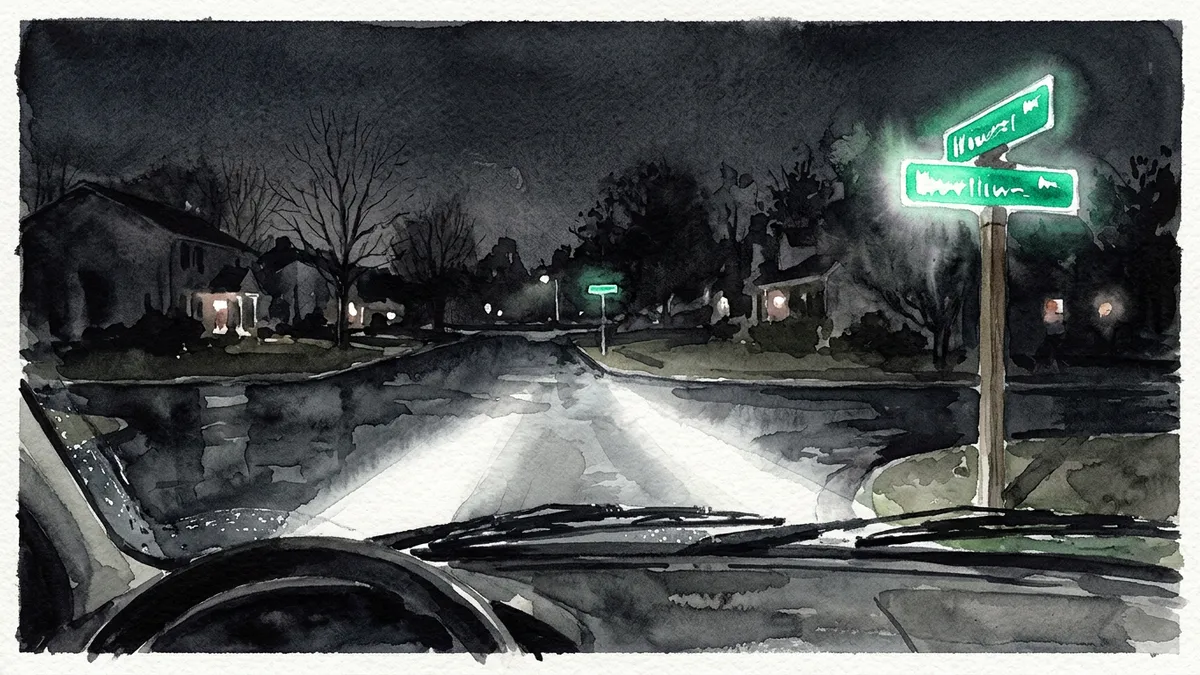
Nighttime navigation is especially important for firefighters, ambulance crews, and police. Between leaving their station and arriving at the scene, every second counts. Reflective Street Name Signs send the light from their vehicle headlights back toward the driver, so the street name stays readable no matter the time of night.
Common Reflective Sheeting Types
As mandated by federal MUTCD standards, traffic signs must be retroreflective or illuminated (2A.21), and public agencies must keep them above minimum retroreflectivity levels (2A.22). The ASTM D4956 standard classifies sheeting retroreflectivity, and two common product types can be used: HIP or FCP.
High-Intensity Prismatic (HIP)
Most commonly used for city and private roads, HIP sheeting meets federal reflectivity standards while providing other benefits:
- Cost-effective with great performance
- 10-year outdoor durability
- Excellent nighttime visibility
Full-Cube Prismatic (FCP)
Typically used on higher-speed roads, FCP sheeting returns much more light for:
- Enhanced readability from a distance
- Maximum visibility for overhead signs
- Meeting specific state or local requirements
FCP sheeting is rated for 12 years of outdoor durability. Using an anti-graffiti protective overlaminate extends the HIP lifetime from 10 to 12 years and the FCP lifetime from 12 to 15 years. Our Street Name Signs include this anti-graffiti film at no extra charge (see our Street Name Sign FAQ).
Minimum Retroreflectivity for Street Name Signs
The MUTCD sets minimum retroreflectivity levels that street name signs must keep as they age (Table 2A-5). Overhead signs need roughly twice the brightness of post-mounted signs.
| Sign Color | Post-Mounted | Overhead |
|---|---|---|
| White on Green | White ≥ 120; Green ≥ 15 | White ≥ 250; Green ≥ 25 |
| White on Blue | White ≥ 120; Blue ≥ 7 | White ≥ 250; Blue ≥ 12 |
| White on Brown | White ≥ 150; Brown ≥ 5 | White ≥ 350; Brown ≥ 10 |
Values are in candelas per lux per square meter (cd/lx/m²). These are minimums the sign must still meet as it ages, not the brightness of new sheeting. Both HIP and FCP start well above them.
Which Sheeting Is Best for Different Applications?
When considering which reflective Street Name Sign material to choose, take a look at common applications of both HIP and FCP sheeting:
- HOAs and residential developments typically use HIP, unless FCP is chosen for a premium upgrade.
- Municipal streets use HIP and sometimes FCP depending on agency specifications.
- Higher-speed roads tend to favor FCP sheeting for its increased visibility from a distance.
For HOA and private road signs, see Custom Street Name Signs for HOAs, Neighborhoods, and Private Roads.
State and Local Requirements
HIP and FCP sheeting are both MUTCD-compliant, but states and cities can set their own sheeting specifications. Some agencies allow HIP, while others require FCP for its brighter appearance at night.
The MUTCD applies to all public roads, but also applies to many private roads with public access (1B.01). Apartment complexes, office parks, and shopping centers often fall under this rule. Street Name Signs on those roads must be retroreflective and meet any local sheeting specifications.
Understanding Product Names vs. Sheeting Classes
The same sheeting class can be sold across several proprietary product names, depending on the agency or manufacturer. Comparing HIP and FCP products calls for a critical eye and a focus on the properties of the sheeting itself. Look for the following:
- The sheeting class and type (ASTM or equivalent standards)
- Reflectivity that meets agency and project requirements
- The expected material performance
Conclusion
Street Name Signs benefit from the reflectivity, visibility, and readability that HIP and FCP sheeting bring. Both materials have excellent performance, so take visibility, durability, project requirements, and budget into account as you determine which sheeting works best for your project needs. Build your sign in our custom street sign builder, and see MUTCD Guide Signs Explained for street name sign colors.