MUTCD Guide Signs Explained: Colors, Uses, and Modifications
Published
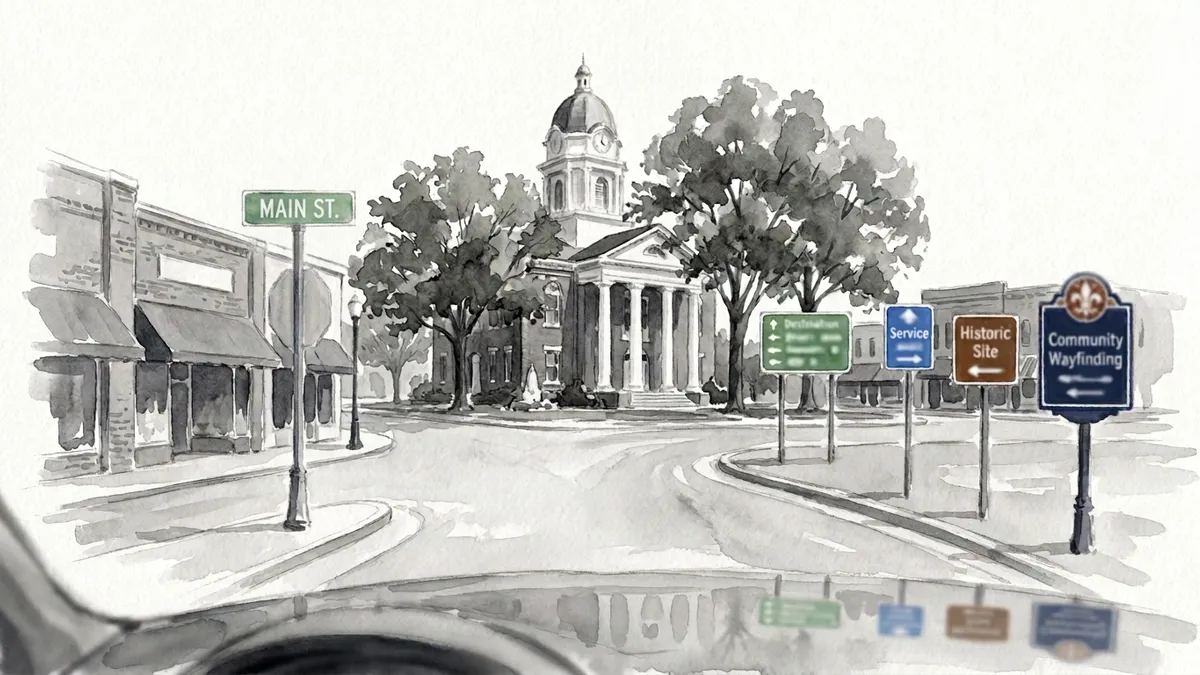
Introduction
The MUTCD sorts traffic signs into three categories (2A.03): Regulatory Signs set the rules, Warning Signs alert drivers to conditions ahead, and Guide Signs set up a wayfinding system. See Regulatory vs. Warning vs. Guide Signs for how the three compare.
With the help of Guide Signs, drivers can start from any location and find their way to their destination. As an important navigation aid, Guide Signs:
- Direct drivers toward turns and exits
- Inform them of nearby towns, amenities, and features
- Identify current and intersecting street names
- Point them toward essential traveler services
For most Guide Signs, the MUTCD requires a green background with the message and border in white. Exceptions to these colors are set elsewhere in the manual, but all Guide Signs must be retroreflective or illuminated for night use (2D.02).
Understanding Standard Guide Sign Colors
Guide Signs are typically grouped together by color. Each color listed below has a collection of MUTCD signs with related uses.
Green – General Guide Signs
Green guide signs help drivers navigate highways and local roads.
- Directional guidance – uses arrows to point to a turn
- Street names – identifies a street by its official name
- Exit information – names the road or city the exit leads to
- Destination distances – shows the remaining miles until a destination is reached
Blue – Service Signs
Blue service signs tell travelers of nearby services, rest areas, and food stops.
- Fueling Stations
- Gas, EV, ethanol, and diesel stations
- Food
- Fast food and local restaurants
- Lodging
- Hotels, motels, and inns
- Emergency Services
- Police, ambulance, and hospital
- Rest Areas
- Tourist information and other traveler services
- Camping
- Trailer camping and sanitary stations
Brown – Recreational & Cultural Signs
Brown guide signs point tourists toward popular points of interest.
- Parks
- Shows the way to national, state, or local parks
- Historic Sites
- Marks sites that are historically significant
- Campgrounds
- Directs travelers to overnight accommodations
- Recreational Areas
- Invites visitors into recreational activity areas
Both blue and brown guide signs are used for campgrounds. Blue signs point to campgrounds as a traveler service, and brown signs are used when camping is a recreational activity.
Assorted Colors – Community Wayfinding Signs
Community Wayfinding Signs have messaging, logos, and colors unique to the city or town. Most but not all colors can be used for Community Wayfinding Signs. To avoid confusion with regulatory and warning signs, they can’t use these background colors:
- Red
- Orange
- Yellow
- Purple
- Fluorescent yellow-green
- Fluorescent pink
As a rule, Community Wayfinding Signs can’t use any of these background colors above, fluorescent or otherwise. Other colors, including green, blue, and brown, can be used, as long as there’s a 70% contrast or more between the background and legend (2D.55).
Common Guide Sign Customizations
Destination Signs
Destination Signs, and related signs like Exit Signs or Advance Guide Signs, can use:
- Custom destination names
- One, two, or three names
- Directional arrows
- Pointing up, right, left, or at an angle
- Number of miles
- One-, two-, or three-digit miles
The names, arrows, and distances change from sign to sign, but the design does not. Official design standards from the MUTCD and Standard Highway Signs still apply.
Street Name Signs
For both post-mounted and overhead Street Name Signs, the background color can be changed. The MUTCD allows only three alternative colors (2D.45):
- Blue
- Brown
- White
Blue and brown signs have white lettering, and white signs have black lettering. Other street signs in this category, such as Advance Street Name Signs, can’t have their green color substituted for others (2D.46).
Community Wayfinding Signs
Community Wayfinding Signs for roads in downtowns or historic districts help build a unique local identity. Some design features often customized include:
- Citywide sign color
- Color-coded routes
- District names
- Municipal logos
- An identification marker
These signs can take on many different appearances, but the MUTCD still sets standards for their design and use. Some rules for Community Wayfinding Signs include (2D.55):
- Only allowed on conventional roads, not on freeways or expressways
- Limited to post mounting, not overhead
- Can’t replace standard guide signs, such as destination or street signs
Other standards are described in detail in Section 2D.55 of the MUTCD.
Conclusion
Guide Signs on public roads greatly help drivers as they travel to their destination. With MUTCD-compliant color, messaging, and modifications, Guide Signs keep navigation simple, safe, and effective.