MUTCD Warning Signs Explained: Colors, Shapes, and Meanings
Published
Introduction
The Warning Signs you see on roadsides are best used for pointing out upcoming hazards, describing the state of the road, or explaining how the roadway itself is changing form.
Federal MUTCD guidance places Warning Signs alongside Regulatory Signs and Guide Signs as the three main sign categories:
- Regulatory Signs establish the basic driving rules on the road.
- Guide Signs help drivers find their way to their destination.
- Warning Signs inform drivers of road conditions ahead that might not be readily apparent.
Standardizing the color, shape, and meaning of Warning Signs ensures that hazard messaging stays consistent nationwide. Most Warning Signs are grouped under the W-series of traffic signs in the MUTCD.
Colors and Shapes
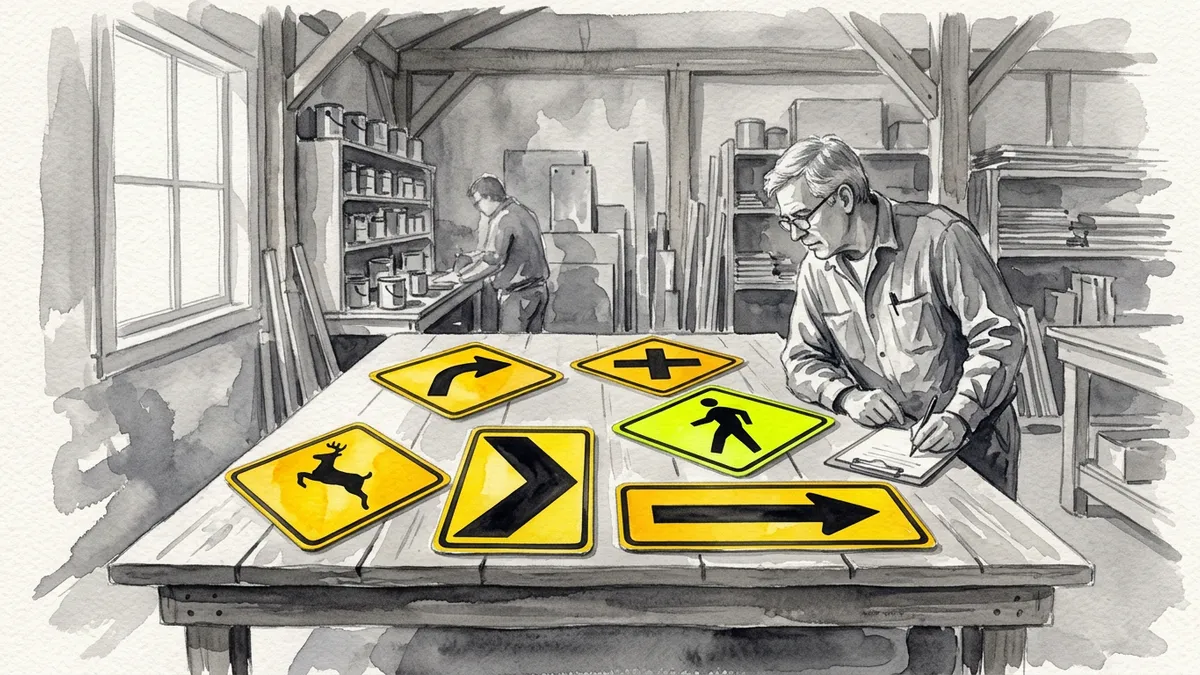
The Yellow Diamond Shape of Warning Signs
Most Warning Signs share the following three design features:
- Diamond shape
- Yellow background
- Black symbol and/or text
Their unique color and shape visually contrast with the typical black and white of Regulatory Signs and the green or blue of Guide Signs. Important to note is that all diamond-shaped road signs are similar in shape to a rounded square that’s been rotated 45 degrees.
There are a few exceptions. Work zone warning signs are orange, and incident warning signs may be fluorescent pink. Some warning signs, such as chevrons, large arrows, and supplemental plaques, are rectangles.
When Fluorescent Yellow-Green Signs are Used
Fluorescent Warning Signs, specifically in a unique yellow-green, are a more visible alternative to the standard yellow color. Only the following categories of Warning Signs can substitute in fluorescent yellow-green sheeting (2C.02, 08):
In school zones, however, fluorescent yellow-green Warning Signs are always required to be used for signs like (2C.02, 09):
- School Signs
- School Bus Stop Ahead Signs
- The plaques mounted with them
The Meanings Behind Warning Signs
The MUTCD sorts Warning Signs into nine groups in Chapter 2C. The four categories below cover the signs most often used, each with their own distinct uses.
| Category | How They’re Used | Design Features | Common Signs |
|---|---|---|---|
| Curve & Alignment | To warn of curves and turns in the road ahead | Curved arrows to match road shape | W1-2 Curve Signs W1-8 Chevron Alignment Signs |
| Intersection & Cross Traffic | To warn of a crossroad, stop, or signal ahead that drivers might not see in time | Lines that represent the intersection layout | W2-1 Crossroad Signs W3-1 Stop Ahead Signs |
| Pedestrian & School | To mark the presence of pedestrians and schoolchildren at high-risk locations | Yellow or fluorescent yellow-green; fluorescent yellow-green required for school signs | W11-2 Pedestrian Crossing Signs S1-1 School Signs |
| Road Conditions | To prevent road hazards from taking drivers by surprise | Words and/or symbols that represent the road condition | W8-1 Bump Signs W12-2 Low Clearance With Height And Arrow Signs |
Conclusion
With their standardized, easily recognized designs, MUTCD Warning Signs guide drivers through changing roadway conditions. Each sign’s use of symbols and/or text provides every driver reliable, predictable notice of hazards ahead, making sure they stay safe on their travels.