Standard Traffic Sign Shapes and What They Mean
Published · Updated
Introduction
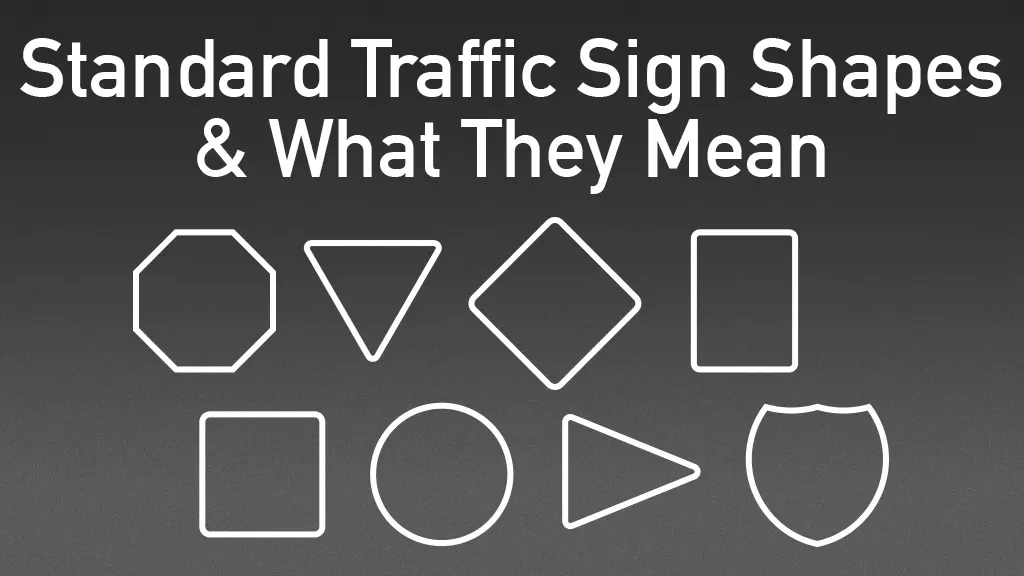
Using visually distinct shapes allows for instant recognition of a traffic sign with one quick look, even in lowlight or inclement weather conditions. For standard traffic signs, each shape and its meaning provide the frame for drivers to start taking in more specific details about the sign in their line of sight.
| Shape | Meaning | Common Examples |
|---|---|---|
| Octagon | Stop | Stop Signs |
| Triangle | Yield | Yield Signs |
| Diamond | Warning — alerts drivers to hazards or changing road conditions ahead | Pedestrian Crossing, Speed Hump |
| Rectangle | Regulations or guidance — conveys rules drivers must follow or directional information | Speed Limit, No Parking, Destination |
| Pentagon | School-related — used exclusively for school zone warnings | School Zone Signs |
| Circle | Railroad warning — alerts drivers of an upcoming railroad crossing | Railroad Crossing Advance Warning |
| Crossbuck | Railroad crossing — marks the exact location of a railroad crossing | Railroad Crossing Signs |
| Pennant (Flag) | Railroad no passing — marks the beginning of a no passing zone | No Passing Zone Signs |
| Shield | Interstate route marker — identifies interstate highways | Interstate Signs |
| Misc. Shapes | Route markers — identifies county and state routes | State Route Signs |
Octagon: The Stop Sign
Several distinct signs you see on roadsides have a 1-to-1 relation, where one shape is reserved for only one sign and message. One of those is the octagon, which is the shape of what’s arguably the most representative of all traffic signs: the Stop Sign. Independently of its bright red color, it’s easy to recognize the octagon shape of a Stop Sign, even from a distance, from behind, or from an angle.
Triangle: The Yield Sign
The triangle, specifically referred to as the inverted triangle in the MUTCD, is used for one sign message alone: the Yield Sign. Similarly to the Stop Sign, a Yield Sign controls traffic flow, in this case by reminding drivers to “yield” the right-of-way and give other traffic first priority. The shared red and white color link the Stop and Yield Sign together as traffic control signs, but are visually very distinct in their octagonal and triangular shapes, respectively.
Diamond: Warning Signs
The diamond shape of these signs isn’t the typical diamond shape that may first come to mind. Each of the four sides of the sign are equal in length, and the overall design most closely resembles a square rotated 45 degrees. Diamond-shaped signs represent any “warning” and alerts drivers to take caution as they continue down the road. Messaging communicates upcoming changes in the road itself (Curve Ahead, Speed Hump) or hazards of any sort (Vertical Clearance, Truck Rollover).
Rectangles: Regulatory and Guide Signs
Rectangle signs as a category includes signs in a wide range of dimensions, but overall appear in two overarching variations. Vertical rectangles typically contain regulatory information that “regulates” the road in terms of speed, direction, or prohibited turns, as Speed Limit, One Way, and Turn Prohibited Signs do. In contrast, horizontal rectangles are usually used for navigational information, whether that be through guide signs like Destination Signs or directional signs like Exit Signs. For rectangular signs, the shape is not the most defining feature because the color, messaging, and layout provide the bulk of what a sign means.
Pentagon: School Signs
The standard pentagon sign is shaped similarly to a baseball home plate, pointing side up. You’ll see pentagon signs as School Signs only in school zones, marking the beginning of a zone and any school crossings within. These signs are always fluorescent yellow-green in color, and the combination of its unique pentagon shape and color make it easy for drivers to spot and recognize. This is a key advantage in protecting students at public schools, daycares, and private campuses as they walk around the school zone.
Circle: Railroad Warning Sign
There are three sign shapes that are dedicated to railroad crossing messaging, the first of which are circle signs. This shape of sign is singularly associated with Railroad Crossing Advance Warning Signs, which have the purpose of warning drivers that a railroad crossing is ahead. The yellow background paired with black text and symbols matches the color combination of other permanently installed warning signs.
Crossbuck: Railroad Crossing Sign
The only crossbuck-shaped traffic sign in federal guidance is the Railroad Crossing Sign, which is an assembly of two horizontal rectangles layered one over the other at a 90-degree angle. An interesting fact about these signs is that strips of white reflective sheeting must be applied to the back side of this sign, onto each component of the crossbuck assembly. Combined with its unique shape, the sheeting helps ensure visibility in the nighttime or when the Railroad Crossing Sign may be hard to spot.
Pennant (Flag): No Passing Zone Sign
The pennant, or flag, traffic sign shape is used only for the No Passing Zone Sign that’s optionally placed in advance of a railroad crossing. What’s unique about this sign is two things: its flag shape and the fact that it is only allowed to be posted on the left-hand side of the roadway. The sign is an optional addition to emphasize the Do Not Pass Sign and its related pavement markings.
Shield Signs: Interstate Route Signs
With its combination of its two-color, red-and-blue background and shield shape, the Interstate Route Sign is very easily distinguished from all other traffic signs. The shield-shaped sign reads “Interstate” at the top with the route number below. Signs may include the state name printed above the route number.
Miscellaneous Shapes: Route Signs
This catch-all category rounds out the traffic sign shapes that we’ve listed so far.
For US Route Signs, the shield design used is slightly different to Interstate Signs. A white shield is printed onto a rectangular sign with a black background and route number. Although not strictly a sign with aluminum cut into a shield shape, US Route Signs are designed to be a complement to Interstate Signs.
Because State Route Signs are solely designed and put in place by each state’s Department of Transportation, signs can take on any appearance in terms of shape, design, and layout. Most notably and distinctly designed, a California State Route Sign is a green, rounded triangle shape that resembles the leaf of a clover.
With their distinct blue and yellow color, County Route Signs are shaped to be a pentagon resembling one you may find on a soccer ball with a slightly rounded top.
Frequently Asked Questions
Why make signs in different shapes, and not all the same?
When one sign shape is associated with one general message, it’s easy for drivers to quickly categorize a sign at a glance.
Why use an octagon for Stop Signs?
Stop Signs are the only octagonal sign on the road for ease of recognition and for preventing any kind of confusion or ambiguity
Why are warning signs diamond-shaped?
The diamond shape establishes a category of signs with advisory messaging. Whenever a driver sees one of these signs, they know to take caution based on the messaging included via text or symbol.
Are all rectangular signs considered regulatory signs?
No, not quite. While vertical rectangle signs tend to be regulatory ones, it’s not a failsafe rule. Additionally, horizontal signs are typically directional or guide signs.
Conclusion
Like color, layout, and messaging, shape creates a meaningful distinction among traffic sign categories. Quickly recognizable signs improve message comprehension, provide consistency for the sign system, and ultimately make roadways safer for all road users.