Symbol vs. Text “Flagger Ahead” Signs – Which Should You Use?
Published
Introduction
Construction sites designate flaggers when active oversight of traffic flow is needed—especially when there is heavy machinery in operation or only one lane is open on a two-lane road. Section 6H.15 of the MUTCD requires a Flagger Ahead Sign installed in advance. Two sign designs meet this standard: one with a symbol legend, and the other with text. Both are compliant, so which to choose depends on several factors.
The Two Common Sign Versions
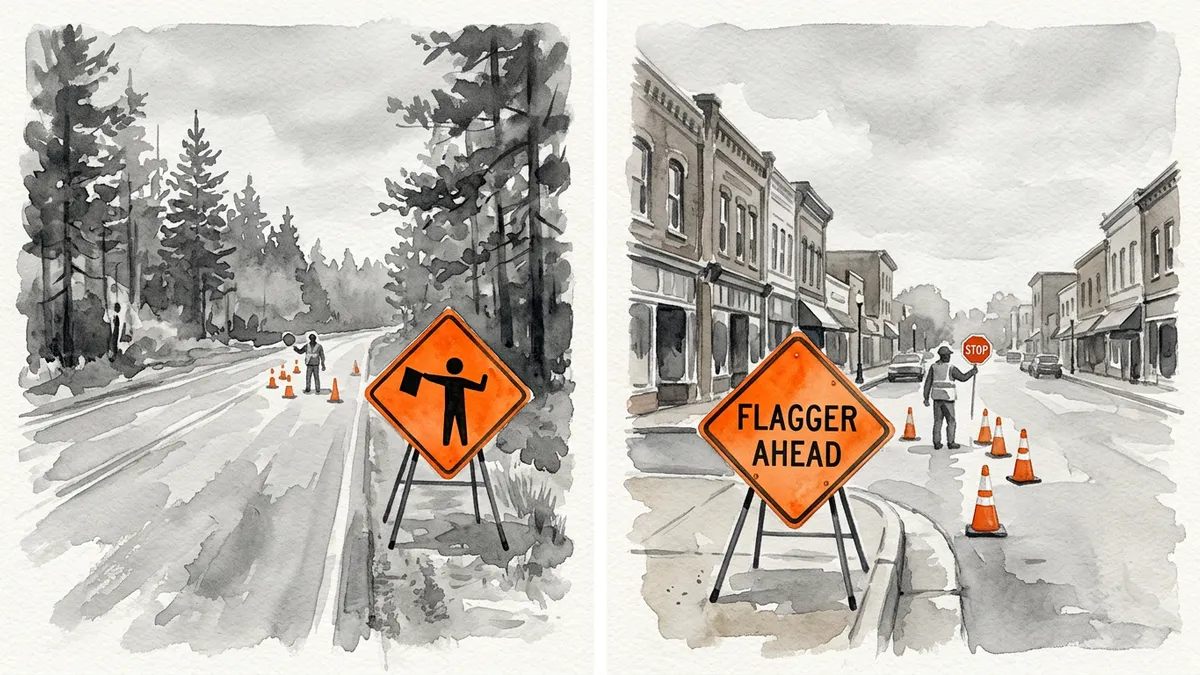
Even with their differing appearances, the symbol sign and the text sign function in the exact same way—warning drivers about upcoming manual traffic control:
-
W20-7 Flagger Ahead Symbol Sign
- Symbol of a flagger holding a raised flag
- Modern MUTCD standard
-
W20-7A Flagger Ahead Sign
- “FLAGGER” + Distance Legend
- Alternative to the symbol sign
Industry best practices call for consistency in temporary traffic control (TTC) work zone signage. It’s ideal—and often in local code—to use only one version within a work zone.
How Flaggers Control Traffic
Flaggers pair a hand-signaling device with gestures to stop traffic, let traffic proceed as normal, or to slow traffic down. Using a STOP/SLOW Paddle is the preferred method in the MUTCD—however, in emergency situations, a handheld red flag can be used (Figure 6D-1).
Why Symbol Signs Are Becoming More Common
In recent years, MUTCD symbol signs have become more widespread in use—the FHWA continues to adopt new symbols after in-depth research (2A.09, 03). An advantage of symbol signage is that it’s easier for drivers to recognize at a glance when compared to text signs. Quick reaction time is key in protecting driver and worker safety, and the faster a sign’s messaging can be understood, the faster drivers know how to adapt their actions to the road conditions.
Why Text Signs Are Still Widely Used
Even with the overall preference for symbol signs, Flagger Ahead Signs with word messaging are still considered an acceptable choice for temporary traffic control (TTC). There are several reasons this is the case, including the fact that:
- Some local and state agencies specify the word sign
- Contractors may already own large inventories
- Using the word “Flagger” makes sign messaging very clear
Which Option Should You Choose?
Sign choice typically depends on each jurisdiction’s preference, and consistency in sign style matters. If local traffic authorities don’t have specific requirements on which Flagger Ahead Sign version to use, take these considerations into account:
- In the current MUTCD, symbol signs are the standard choice for quick recognition.
- Text signs are still commonly used by long-time contractors and for traditional sign setups.
Conclusion
Symbol and text Flagger Ahead Signs are both federally compliant, but some local jurisdictions may specify only one of the two. Even though text signs are still widely used, their symbol sign equivalent is the preferred, easily recognized choice for modern TTC applications.