No Stopping & No Standing Signs
No Stopping and No Standing signs are the two strictest curb restrictions — tighter than No Parking. A No Stopping sign means you cannot stop at all; a No Standing sign lets you stop only for a moment to pick up or drop off passengers. Below is the plain-English difference, followed by the MUTCD R7-4 signs, printed on rust-proof .080" aluminum with reflective sheeting.
No Stopping vs. No Standing vs. No Parking
| Sign | Stop at all? | Pick up / drop off passengers? | Load / unload goods? | Park (leave unattended)? |
|---|---|---|---|---|
| No Stopping | No (except traffic/signal) | No | No | No |
| No Standing | Briefly | Yes (driver stays) | No | No |
| No Parking | Yes | Yes | Yes | No |
Rule of thumb: every No Standing zone is also a no-parking zone, and every No Stopping zone is also a no-standing zone — each sign adds one more level of restriction.
No Stopping & No Standing Signs (MUTCD R7-4)
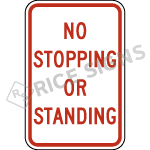 No Stopping Or Standing (R7-4-1)
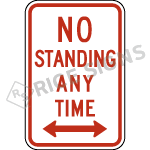 No Standing Any Time (R7-4)
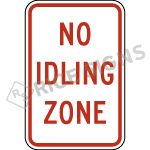 No Idling Zone (R7-4-2)
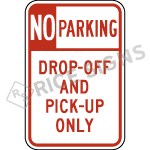 Drop Off & Pick Up Only (R7-4-3)
No Stopping & No Standing Signs FAQ
What is the difference between No Stopping, No Standing, and No Parking?
They are three levels of restriction. No Stopping is the strictest — you cannot stop at all except to obey traffic or a signal. No Standing lets you stop only momentarily to pick up or drop off passengers, but you cannot wait. No Parking lets you stop to load or unload goods or passengers, but you cannot leave the vehicle parked and unattended.
What does a No Stopping sign mean?
A No Stopping sign means you may not stop your vehicle in that area for any reason other than to avoid conflict with traffic or to obey a traffic control device. You cannot stop to load, unload, or wait, even briefly. It is the most restrictive of the parking-prohibition signs.
What does a No Standing sign mean?
A No Standing sign means you may stop only long enough to pick up or drop off passengers, and the driver must stay with the vehicle. You cannot wait, park, or load and unload goods. It is common in cities such as New York for bus stops, hydrants, and busy curbs.
Does No Standing mean No Parking?
No Standing is stricter than No Parking. Both prohibit leaving a parked vehicle, but No Parking still allows you to stop to load or unload goods, while No Standing only allows a momentary stop for passengers. So every No Standing zone is also a no-parking zone, but not the reverse.
Can you stop at a No Standing sign?
Only briefly, and only to pick up or drop off passengers while the driver remains with the vehicle. You cannot wait for someone, and you cannot load or unload packages or freight.
Can you stop at a No Stopping sign?
No. A No Stopping sign prohibits stopping entirely, except when you must stop to avoid a collision or to comply with a traffic officer or signal. You cannot stop for passengers or deliveries.
What is a No Stopping Any Time sign?
A No Stopping Any Time sign applies the no-stopping rule 24 hours a day rather than only during set hours. We can supply the No Stopping Or Standing sign (R7-4-1) and can print a custom No Stopping Any Time legend when a full-time restriction must be posted.
Why does New York City use No Standing signs?
New York City relies heavily on No Standing signs to keep bus stops, hydrants, loading areas, and busy corners clear while still letting drivers briefly pick up or drop off passengers. The signs we sell meet MUTCD conventions and can be customized with hours or arrows for any city’s rules.
What color are No Stopping and No Standing signs?
They are white with a red legend and border, the standard color scheme for parking-prohibition signs, so the restriction reads clearly from a distance. Directional arrows and hours can be added in the same red-on-white format.
What size and material are the signs, and can I customize the wording?
Standard sizes are 12x18 inches and 18x24 inches for higher visibility. Signs are printed on rust-proof .080" aluminum with reflective sheeting, and we can customize the wording, hours, and arrows to match your local ordinance.