Roundabout Signs
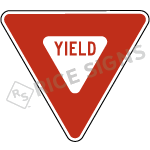
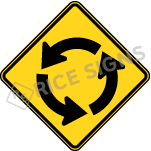
Also known as a traffic circle, a roundabout keeps vehicular traffic moving in a counterclockwise circle. The roundabout signs below help drivers safely enter, navigate, and exit roundabouts of any size or shape — including the MUTCD Circular Intersection (W2-6), Roundabout Circulation (R6-5P), roundabout lane-arrow signs, the Yield sign (R1-2) used at roundabout entries, and Roundabout / Traffic Circle placards, on rust-proof .080" aluminum.
| SKU # | Sign Name | How They’re Used |
|---|---|---|
| W2-6 | Circular Intersection Sign | Signals that a roundabout will be further down the road |
| R6-5P | Roundabout Circulation Sign | Marks a roundabout, posted on the central island or below the yield sign |
| R3-8 Series | Advance Intersection Lane Control Signs | Displays a roundabout’s lane geometry and how exiting roads are laid out |
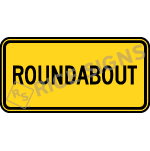
| W16-17P | Roundabout Placard | Identifies a roundabout by name, mounted below the W2-6 sign |
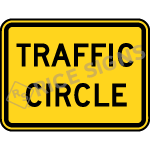
| W16-12P | Traffic Circle Placard | Names the circular intersection with its alternate term |
Roundabout Circulation Signs
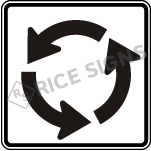 Roundabout Circulation (R6-5P)
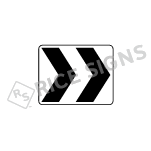 Roundabout Two Arrows (R6-4)
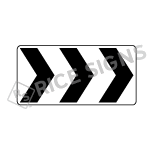 Roundabout Three Arrows (R6-4a)
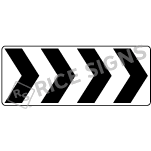 Roundabout Four Arrows (R6-4b)
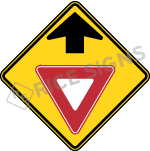
Roundabout Approach Signs (Yield & Circular Intersection)
Roundabout & Traffic Circle Placards
Roundabout Signs FAQ
Which Roundabout Signs should I choose?
As a guide, here’s a rundown of how each sign is used:
- W2-6 – Circular Intersection: required when roads are 40 mph or higher, optional otherwise (2C.41).
- R6-5P – Roundabout Circulation Sign: required at any roundabout, posted at the central island or below the Yield sign (2B.51).
- R3-8 Series – Advance Intersection Lane Control Signs: best used when roundabouts have 2+ lanes or a unique lane configuration (2B.30).
- W16-17P / W16-12P – Roundabout / Traffic Circle Placards: optionally posted below the W2-6 to give drivers additional notice.
What other signs are used with Roundabout Signs?
Related signs you’ll commonly see at these circular intersections include:
- Yield Signs (R1-2) – mounted at the roundabout entry point.
- One-Way or Keep Right Signs – posted on the central island, pointing right.
- Pedestrian Crossing Signs – placed at the entry point, typically paired with pavement markings.
To highlight that left turns are prohibited, the R3-2, R3-4, or R3-18 sign can also be used (2B.26).
How do roundabouts improve safety?
Anchored by a central island, a roundabout’s curved design slows vehicles down for better safety outcomes.
Why have roundabouts become more widespread?
Modern roundabouts are a versatile traffic solution, as the design is endlessly modifiable to the location, traffic volume, and geometry of the entire intersection.
How do drivers enter roundabouts?
Approaching drivers yield to the circular traffic flow, only entering the roundabout when traffic from the left clears.