Why Do Modern Street Name Signs Use Mixed-Case Letters?
Published
Introduction
Mixed-case lettering has become the modern standard for Street Name Signs. The MUTCD requires Street Name Signs in lower-case letters with initial upper-case letters (2D.45). On older Street Name Signs, you might notice street names in all-capital letters. As those signs wear out and get replaced, you’ll surely see more mixed-case signs over time.
What Is Mixed-Case Lettering?
Mixed-case lettering is when the first letter of a word is upper-case, followed by all lower-case letters. This is a feature of modern Street Name Signs. The MUTCD sets a specific standard for the lower-case letter height. This “loop height” is three-quarters of the initial upper-case letter height (2A.08).
What Does the MUTCD Require?
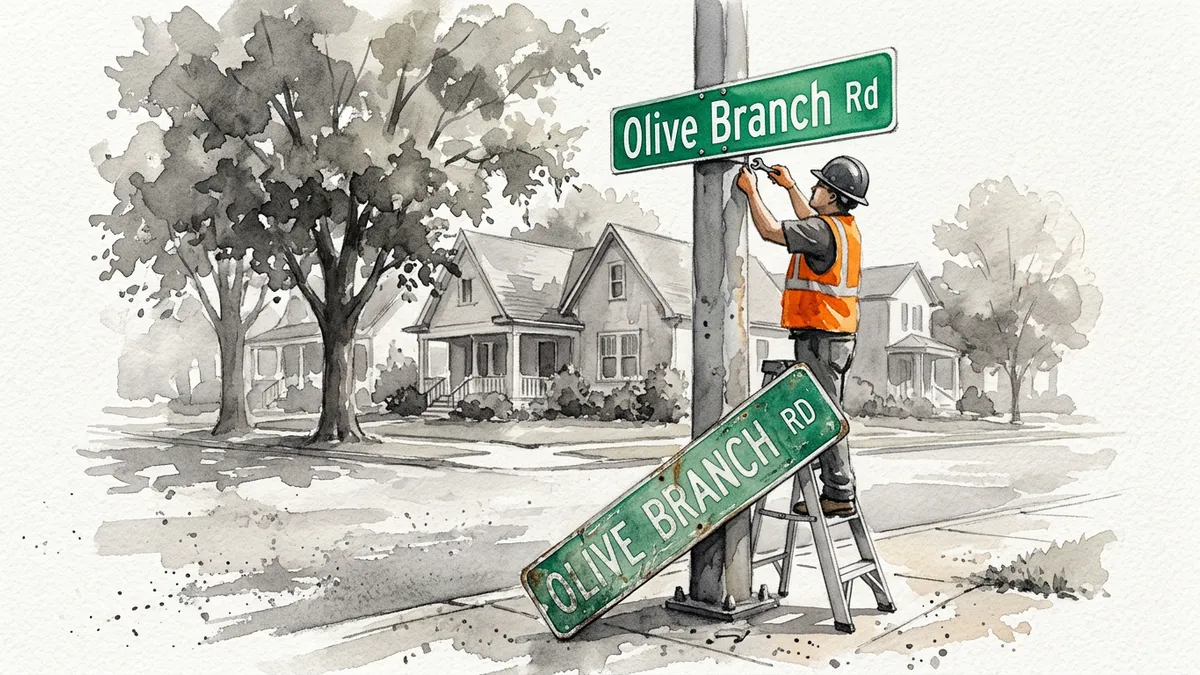
Looking at the comparison between old and new, it may appear to be upper-case vs. lower-case street signs. The true difference, however, is between all-caps vs. mixed-case lettering. For instance, an older style of Street Name Signs may have used “OLIVE BRANCH RD,” but modern signs would use “Olive Branch Rd.”
The MUTCD requires the names of places, streets, and highways on guide signs to use mixed-case lettering, while other words on guide signs, such as “NEXT RIGHT,” use all upper-case letters (2A.08, 2D.04).
The MUTCD also references another official publication in its Street Name Sign standards. The Standard Highway Signs, issued by the Federal Highway Administration (FHWA), lists the required letter designs.
Why Mixed-Case Signs Are Easier to Read
Street Name Sign readability is improved with mixed-case signs because drivers tend to identify words by their overall shape. Lower-case letters with ascenders (b, d, h) stand tall, and letters with descenders (g, j, p) drop below.
Continuing the above example, outlining the words “Olive Branch Rd” creates a distinct word shape. That’s very different from the rectangular form of “OLIVE BRANCH RD.” With its uniform shape, all-capital lettering can slow down quick recognition of a street name.
What About Series B, C, and D Lettering?
The MUTCD requires sign lettering to use the FHWA Standard Alphabets (2A.08), which come in several widths called series. The narrowest is Series B, and the widest is Series F. Long street names generally need narrow letters to fit on the sign, and wider letters can make signs more readable.
Street Sign letter designs are outlined in the Standard Highway Signs publication, but check with local requirements. Many agencies use Series C or D lettering and may set additional specifications as well.
Other Factors That Affect Readability
Mixed-case lettering is used on Street Name Signs for improved readability, but the lettering style itself isn’t the only factor in how easily a sign can be read. Excluding the sign size, other design elements that affect readability include:
- Letter height and width – how tall and wide each letter is
- Nighttime visibility – HIP vs. FCP materials
- Sign placement – making sure no obstructions block the line of sight
- Color contrast – white on a green background, with blue, brown, and white as alternatives (see MUTCD Guide Signs Explained)
- Abbreviations – shortening signs with “Rd,” “Ave,” and “Blvd”
State and Local Requirements
As part of comprehensive documentation on the design of Street Name Signs, local traffic agencies often specify the following:
- Minimum letter heights
- Approved layouts
- Letter series (font width)
- Blade size and color
Make sure to follow state, county, and municipal requirements. Street Name Signs must be compliant on any private road open to public travel (1B.01). For HOAs and private roads, see Custom Street Name Signs for HOAs, Neighborhoods, and Private Roads.
Conclusion
Street Name Signs can be customized in a wide range of ways, but at their core, the signs function as essential wayfinding devices for any road user. Rather than all-caps lettering on older signs, modern Street Name Signs must use mixed-case lettering. The updated lettering improves readability at a glance—one of the most important ways to ensure sign effectiveness. Design yours in our custom street sign builder, or see our Street Name Sign FAQ.