Where Should Street Name Signs Be Installed?
Published
Introduction
Street Name Signs are among the most common signs, found on city, suburban, and rural roads alike. They serve as a wayfinding device for drivers, bicyclists, and pedestrians. Street Name Signs identify streets by name, but just as important are where you place them and how high they should be mounted.
The Urban vs. Rural Rule: When Street Name Signs Are Needed
When it comes to deciding where to install Street Name Signs, the MUTCD provides a clear, detailed guide. Section 2D.45 outlines how urban and rural areas have different signage needs.
- In urban areas, Street Name Signs should be installed at every intersection. This guidance even applies when there are U.S. Route, County Route, or other Route Markers.
- In rural areas, Street Name Signs should identify important roads that don’t have other signage.
There is one important exception: where a freeway or expressway exit ramp meets a crossroad, a Street Name Sign should not display the name of the freeway or expressway to traffic on the crossroad. Drivers might mistake the exit ramp for a way onto the freeway and drive the wrong way (2D.45).
Street Name Signs: Number and Orientation
A combination of MUTCD guidance and engineering judgment will help you figure out how many Street Name Signs you need. The MUTCD notes four core principles for Street Name Sign placement and orientation (2D.45):
- In business or commercial areas and on principal arterials, place Street Name Signs on at least diagonally opposite corners
- In residential areas, use at least one Street Name Sign at each intersection
- Signs should name both streets at every intersection
- Orient sign faces parallel to the street that they name
No matter where they’re used, Street Name Signs should be double-sided. This helps all road users, but the MUTCD specifically notes that this improves navigation for pedestrians (2D.45).
Mounting Height Standards from the MUTCD
Post-Mounted Signs
Mounting heights are measured from the bottom of the sign to the top of the curb. As you mount Street Name Signs, follow these general MUTCD requirements (2A.15):
- Business, commercial, or residential areas – 7 feet minimum
- Applies specifically where there are parking, bicyclists, or pedestrians
- Where the view of a sign might be obstructed – 7 feet minimum
- Rural areas – 5 feet minimum, measured from the edge of the pavement
- Signs over a sidewalk – a minimum of 7 feet above the sidewalk
If there isn’t a curb present, the mounting height should be measured from the edge of the roadway. Signs can also be installed onto taller Sign Posts to prevent obstructions from blocking the sign view.
Overhead Signs
Overhead Street Name Signs appear beside traffic signals, either mounted onto signal mast arms or span wires. With specialized Overhead Sign Brackets, you can mount signs onto both supports. Like other overhead signs, Overhead Street Name Signs must be mounted at least 17 feet above the road (Figure 2A-2). For overhead sign sizes, see What Size Should a Street Name Sign Be?
Above a Stop or Yield Sign
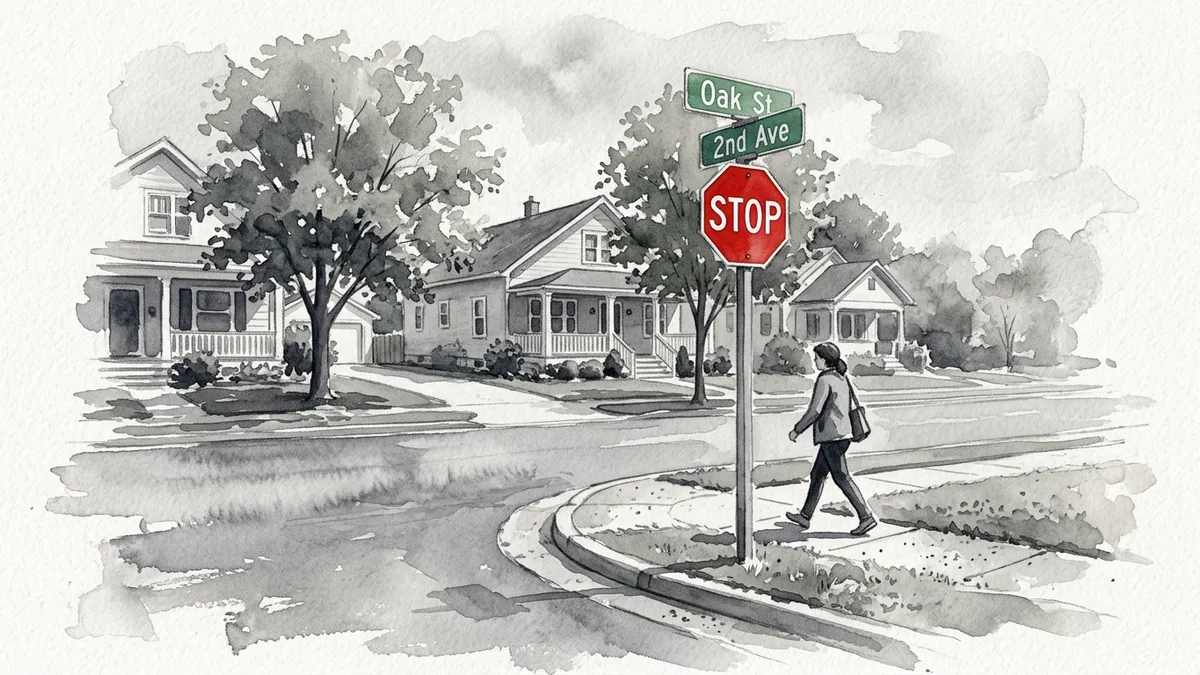
The MUTCD allows Street Name Signs to be mounted on the same post as, and above, a Stop or Yield Sign (2A.13, 2D.45). The minimum mounting height standards still apply to the Stop Sign, Yield Sign, or any other sign that’s below the Street Name Sign.
What About the Distance from the Road?
Section 2A.16 lays out the minimum distance that post-mounted signs should be installed from the road. This is called “lateral offset” in the MUTCD, which recommends at least 12 feet between the edge of the traveled way and the sign, or 6 feet from the edge of a shoulder wider than 6 feet. Lesser distances are common in towns and cities:
- Business, commercial, or residential areas with curbs – at least 2 feet from the face of the curb (Figure 2A-2)
- Where sidewalk width is limited or poles are close to the curb – at least 1 foot from the face of the curb
- Some conventional, low-volume rural, and special-purpose roads – at least 2 feet
- Where terrain, vegetation, or other roadside features limit available space
- Sign posts should not intrude into the usable width of a sidewalk
Pairing Sign Posts to Mounting Hardware
Standard sign brackets are available in several styles alongside their heavy-duty versions, which provide additional stability. With the right hardware, Street Name Signs can be easily installed onto:
- Crashworthy Round, Square, or U-Channel Sign Posts with Street Name Sign Brackets
- Light poles, signal poles, and other large posts with Wing Brackets and Stainless Steel Banding
- Overhead with Mast Arm and Span Wire Sign Brackets
Posts within the clear zone next to the road must be crashworthy, such as with breakaway hardware (2A.16). For more on posts, see Understanding U-Channel Sign Posts.
Conclusion
Take a few MUTCD rules into account, and you’ll know where to install Street Name Signs, how high they go, and how far from the road they should be installed. In most urban areas, Street Name Signs are mounted at least 7 feet high, while in rural areas, they’re mounted at least 5 feet high. Design your signs in our custom street sign builder, or see Custom Street Name Signs for HOAs, Neighborhoods, and Private Roads.