How Do You Choose the Right Sign Stand for a Work Zone?
Published
Introduction
As you set up a utility, maintenance, or construction work zone, temporary traffic control (TTC) signs communicate essential information. To install those signs, you’ll need what the MUTCD calls a portable sign support (6F.02). Most commonly called a sign stand, this device provides the visibility, stability, and portability that TTC signs need in any work zone.
Why Sign Stands Matter
The right sign stand makes all the difference for a TTC sign’s effectiveness. Turbulence from strong winds and passing traffic can knock down signs, but a wind-resistant sign stand is much more likely to stay upright.
Setting up work zone sign stands must be paired with proper placement, so make sure that guardrails, permanent signs, trees, and other potential obstructions aren’t blocking the view of your TTC sign.
In Sections 6F.01 and 6F.02, the MUTCD says:
- Signs should be placed on the right side of the road, with some exceptions
- Sign stands can be placed on the road itself
- The bottom of a sign must be at least 1 foot above the roadway
- Sign stands shouldn’t be placed on sidewalks, bike lanes, or similar travel paths
- Flags or warning lights added to a sign must not block the sign face
Common Types of Sign Stands
Each sign stand design has a different balance of setup speed, portability, wind resistance, adjustability, and cost-effectiveness. Choosing among stands means evaluating what your specific project calls for and weighing your options.
Folding Sign Stands
Tripod stands are our most cost-effective choice for low-speed roads. They’re easy to set up, take down, and fold up tight for compact storage.
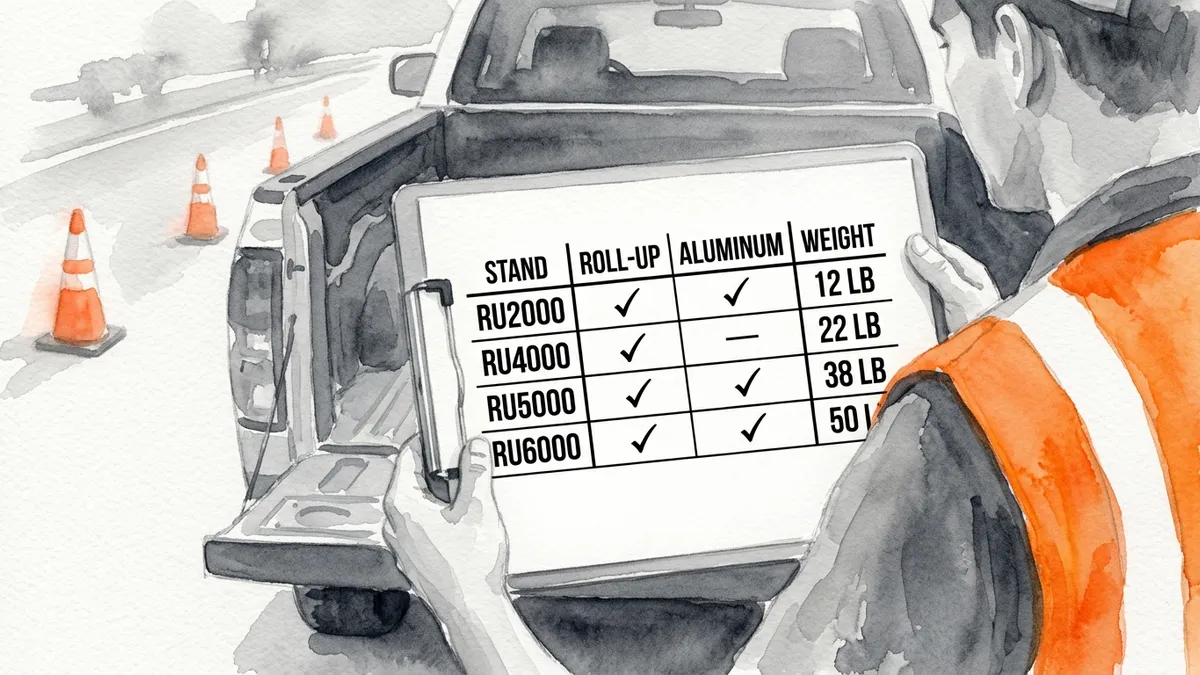
The RU2000 is only for light-duty use. The RU2500 comes in two versions: RU2500-RU, which includes a roll-up bracket, and the RU2500-M that comes with a metal sign bracket. The RU3000 has adjustable legs to stand upright on uneven ground.
| SKU# | Sign Stand Name | Roll-Up Signs | Rigid Signs |
|---|---|---|---|
| RU2000 | Economy Tripod Sign Stand (Light-Duty) | ✓ | ✓ |
| RU2500-RU | Heavy-Duty Tripod Sign Stand (Roll-Up Bracket) | ✓ | — |
| RU2500-M | Heavy-Duty Tripod Sign Stand (Metal Bracket) | — | ✓ |
| RU3000 | Folding Sign Stand for Roll-Up Signs | ✓ | — |
Single Spring-Loaded Sign Stands
This stand is the first step up from basic folding stands. The single spring flexes in turbulent and windy conditions, improving its stability.
Each leg of the RU4000 can be independently adjusted to stay level with the road. Roll-up signs mount easily onto the quick-release bracket.
| SKU# | Sign Stand Name | Roll-Up Signs | Rigid Signs |
|---|---|---|---|
| RU4000 | Single Spring Sign Stand | ✓ | — |
Dual-Spring Sign Stands
These stands improve on the single spring stand design by adding an extra spring. Their dual-spring design improves durability and stability for larger signs used on higher-speed roads.
The RU6000 holds roll-up signs at 7 feet and aluminum signs at 5 feet. Section 6F.02 sets minimum mounting heights of 5 feet in rural areas and 7 feet in business, commercial, or residential areas. With roll-up signs, the RU6000 meets both, and with aluminum signs it meets the rural minimum, so it can be used for long-term projects.
The RU5000 has a lower mounting height, so it’s better suited for short-term projects. The stand holds a 48” x 48” sign at an 18 in. bottom height.
| SKU# | Sign Stand Name | Roll-Up Signs | Rigid Signs |
|---|---|---|---|
| RU5000 | Dual Spring Wind Resistant Sign Stand | ✓ | ✓ |
| RU6000 | Heavy Duty Dual Spring Sign Stand | ✓ | ✓ |
Rubber Sign Stands
These stands feature low-profile, weighted rubber bases that resist road turbulence and wind.
The RURubber sign stand has a 38 lb. rubber base and a 12 in. upright. Roll-up signs are secured with a latch mounting bracket. The R100 sign stand comes with a 6 ft. steel upright, best used where permanent installation isn’t needed or possible.
| SKU# | Sign Stand Name | Roll-Up Signs | Rigid Signs |
|---|---|---|---|
| RURubber | Rubber Sign Stand | ✓ | — |
| R100 | Stackable Portable Rubber Sign Stands | — | ✓ (post-mounted) |
Matching the Stand to the Project
Different project teams prioritize different qualities in their sign stand choice. Below are five example pairings between the project type and the sign stand design.
- Telecommunications workers choose folding stands for short-term jobs on the move.
- Utility maintenance companies choose single-spring stands for better wind resistance.
- Highway engineering teams choose dual-spring stands for maximum wind resistance on interstates.
- Road construction crews choose the RURubber stand to keep roll-up signs stable on paved ground.
- Contractors choose the RU6000 for MUTCD minimum mounting heights on long-term projects.
Wind, Stability, and Safety Considerations
An effective TTC sign is one that stays upright, supported by the proper choice of sign stand. Take the following factors into consideration when selecting a stand:
Road conditions
- Wind exposure – windy areas need sign stands with high wind resistance
- Sign size – larger signs are more easily affected by wind and turbulence
Safety
- Roadway speed – the faster traffic travels, the more robust a stand should be
- Flags – some stands hold up to 3 orange warning flags for more sign visibility (6F.01)
Project duration
- Short-term projects – for 3 days or less, signs can be mounted at a 1-foot minimum height (6F.02)
- Long-term projects – signs should be at the full MUTCD mounting heights, though some signs, such as Road Closed and Detour Arrow signs, are exceptions (6F.02)
State and Local Considerations
The MUTCD requires signs and their supports to be crashworthy (6F.02). That extends to portable sign stands. MASH is the current crash test standard, and it replaced the older NCHRP Report 350. Compliance with MASH means that sign stands have been crash-tested to minimize injury in the case of vehicle impact.
Check with your local agency for specifics on:
- Sign mounting heights
- Approved stand designs
- TTC setup requirements
- Crash test standard (MASH or NCHRP-350)
On federal-aid projects, sign stands made after December 31, 2019 must be MASH-tested, and many state DOTs require MASH for new purchases. Approved product lists differ from agency to agency.
Conclusion
The right sign stand keeps signs upright, visible, and mounted at the right height. Road speed, wind conditions, and sign size matter, so keep these considerations in mind as you make the best sign stand choice for your project.