What Signs Can Improve School Traffic Safety?
Published
Introduction
When school buses and guardians arrive at a school, student pickup and drop-off can be chaotic for teachers, parents, and traffic safety workers. To protect student safety, each city, county, and state agency sets up School Signs to help traffic move more smoothly, quickly, and most importantly, safely.
Why Fluorescent Yellow-Green?
The MUTCD requires a retroreflective, fluorescent yellow-green background for all School Warning Signs (7B.01, 05). The fluorescence helps visibility in bright daylight and overcast weather, while retroreflectivity keeps signs visible at night.
This standard also applies to the “SCHOOL” portion on the S5-1 Sign and all supplemental plaques (7B.01, 05). The legend must be black, with one exception: the School Bus Stop Ahead Symbol Sign adds red to highlight the stop sign and flashing taillights on the bus.
The S1-1 School Sign
The S1-1 School Sign is a uniquely multi-purpose warning sign. There’s some variation in the supporting plaques used—specific sign requirements fully depend on local jurisdiction rules.
When you add supporting signage, the S1-1 sign can be used in four ways:
- School Area – warns that a school area is up ahead
- Usually used on its own
- School Zone – marks the official start of a school zone
- Required wherever state or local statute designates a school zone (7B.02, 04).
- School Advance Crossing – a school crossing is ahead or in XX feet
- Ahead or XX Feet Plaques complete this assembly (7B.02, 02)
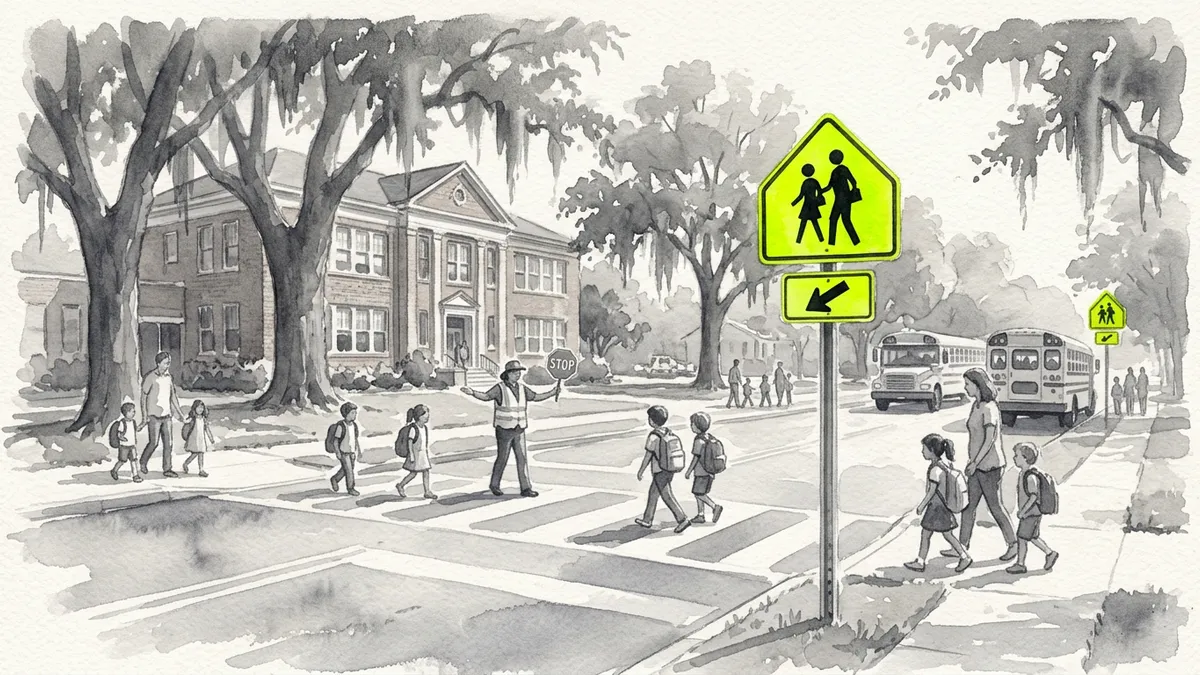
- School Crossing – Points directly to a school crossing
- Add the W16-7P downward arrow plaque (7B.02, 02)
Common School Traffic Signs and Where They’re Placed
The MUTCD sets standards for school signage, but state and local jurisdictions adapt those rules in different ways. In general, they aim to effectively organize vehicle and pedestrian traffic in school zones. Signs are often placed on nearby roadways, at the entrance of the school, and on the school property itself.
Ahead of the School Area
Placing warning signs ahead lets drivers know when they enter a school area or zone. The S1-1 School Sign can be used in this way:
- School area:
- School zone:
Before the School Speed Limit Begins
The S1-1 sign is required ahead of any school speed limit signage (7B.05, 02), such as:
- S4-5 or S4-5a Reduced Speed Limit Ahead
- S5-1 School Speed Limit When Flashing Signs
- Must be used with a flashing beacon
- School Speed Limit Assembly
- Required: R2-1 Speed Limit Sign and S4-3P SCHOOL plaque
- One or more plaques: S4-1P, S4-2P, S4-4P, or S4-6P
Ahead of School Crossings
Before drivers reach a school crossing within a school zone, they should see one of two sign setups (7B.03, 02-03):
- The School Advance Crossing assembly
- The initial School Zone assembly
At School Crossings
Local jurisdictions have several options to consider when marking a school crossing. Those signs include the following:
- S1-1 School Sign assembly – with W16-7P downward arrow plaque
- R1-5 series – ahead of crosswalks
- R1-6 series – in-street signs
- R1-9 series – overhead signs
At the End
The S5-3 is used when the speed limit returns to normal, but the school zone hasn’t ended yet. The S5-2 can be used when the speed limit zone and school zone end together.
Conclusion
A clear, intuitive traffic flow is essential to make the student pickup and drop-off processes flow smoothly and safely. Clear, consistent traffic control ensures that vehicles keep moving and students stay safe. For school traffic signs, MUTCD standards provide the foundation for sign selection, assembly, and placement.