In-Street Pedestrian Crossing Signs
In-street pedestrian crossing signs (MUTCD R1-6) stand in the roadway at a marked crosswalk and tell drivers to stop or yield for pedestrians within the crosswalk. Choose STOP or YIELD based on your state law, a pedestrian or children legend, and a portable weighted base or bolt-down mount. Built using heavy duty molded plastic with reflective sheeting. Base included.
Portable In-Street Signs (Weighted Base)
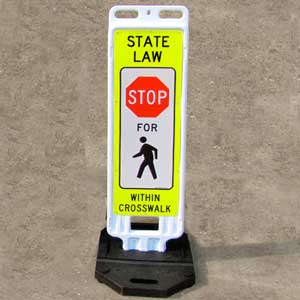 Stop For Pedestrian – Portable (R1-6a-WB)
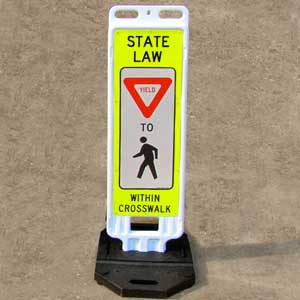 Yield To Pedestrian – Portable (R1-6-WB)
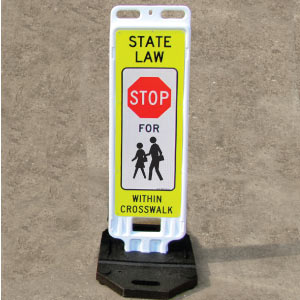 Stop For Children – Portable (R1-6c-WB)
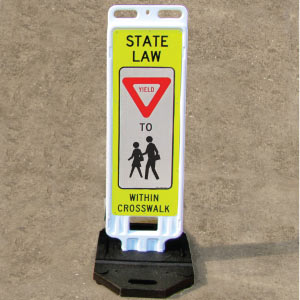 Yield To Children – Portable (R1-6b-WB)
Bolt-Down In-Street Signs
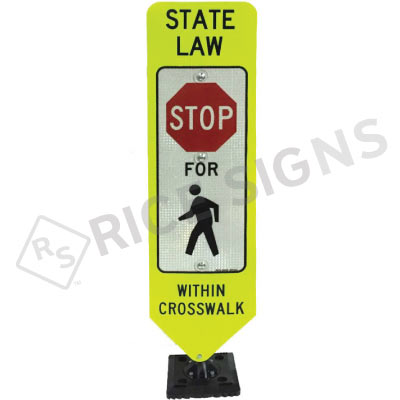 Stop For Pedestrian – Bolt-Down (R1-6a-BD)
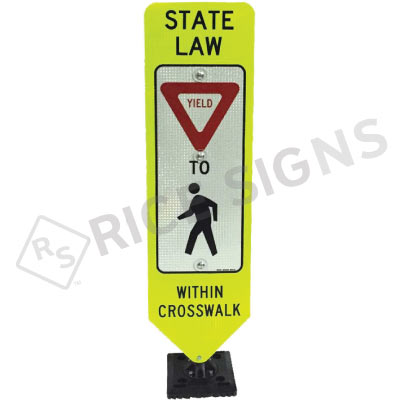 Yield To Pedestrian – Bolt-Down (R1-6-BD)
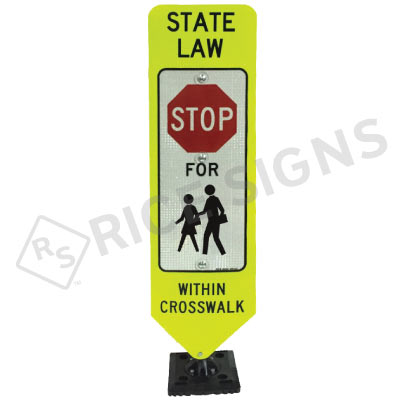 Stop For Children – Bolt-Down (R1-6c-BD)
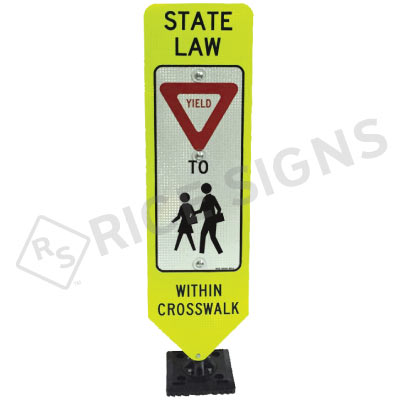 Yield To Children – Bolt-Down (R1-6b-BD)
In-Street Pedestrian Crossing Signs FAQ
What is an in-street pedestrian crossing sign?
An in-street pedestrian crossing sign (MUTCD R1-6) stands in the roadway at a marked crosswalk — on the center line or a lane line — and reminds drivers to stop or yield for pedestrians within the crosswalk. It is highly visible because it sits directly in the driver’s path.
Should I choose a Stop or a Yield in-street sign?
It depends on your state law. Use the Stop For Pedestrians version (R1-6a) in states that require drivers to stop for pedestrians in a crosswalk, and the Yield To Pedestrians version (R1-6) in yield-law states. Check your local traffic-engineering standard if you are unsure.
What is the difference between the portable and bolt-down mounts?
The portable version uses a weighted rubber base (WB) so the sign can be set out and moved as needed, while the bolt-down version (BD) has a base that is permanently anchored to the pavement for a fixed installation.
Are there versions for school zones and children?
Yes. Along with the standard pedestrian legends, we offer Stop For Children (R1-6c) and Yield To Children (R1-6b) versions for school zones and areas with heavy child foot traffic.
Where is an in-street pedestrian sign placed?
It is installed in the roadway at an unsignalized marked crosswalk — typically on the center line, a lane line, or a median island — so approaching drivers see it directly ahead as they reach the crosswalk.
Are in-street pedestrian signs MUTCD compliant, and what materials are used?
The R1-6 series meets MUTCD specifications for public roads. The sign panels are made on rust-proof aluminum with reflective sheeting and mount on a weighted portable base or a bolt-down base.

