When Are Pilot Cars Used in Temporary Traffic Control?
Published
Introduction
When road work limits travel to one lane, crews have to safely manage traffic from both directions. At times, the work zone can be too challenging to navigate, even with the right signs and flaggers. In those cases, temporary traffic control via pilot car is often the best solution. The MUTCD lists this option alongside other one-lane, two-way traffic control methods (6E.01).
How Does a Pilot Car Operation Work?
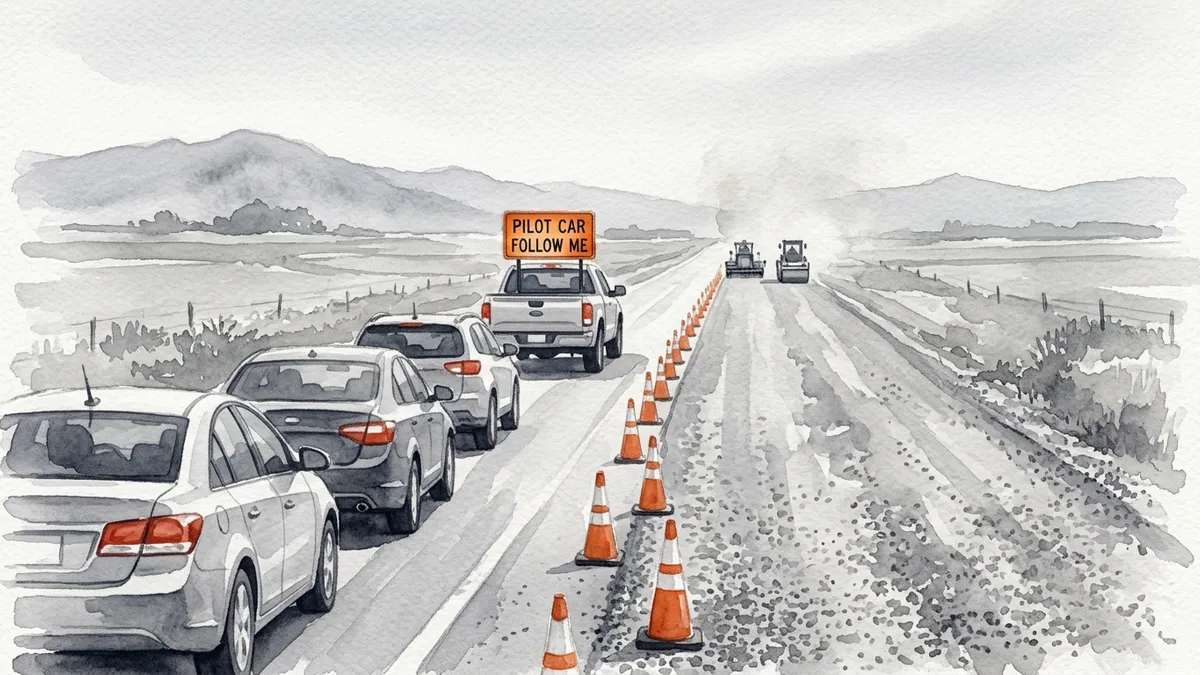
On one-lane roads within a work zone, a pilot car guides drivers through an open travel path that is uniquely complex or very long. This type of temporary traffic control is ideal when there’s limited visibility, long traffic queues, or significant distance to cover.
As pilot car operations are being set up, the MUTCD requires (6E.04):
- A Pilot Car Follow Me Sign (G20-4) mounted on top or at the rear
- A flagger near and within the line of sight of any Automated Flagger Assistance Device (AFAD), which must never be left unattended
Beyond these requirements, the MUTCD gives this guidance for engineers to decide themselves:
- The name of the contractor or contracting authority should be easily seen on the pilot car.
- If TTC signals are being used, notify drivers when there’s a long wait time.
How Are Pilot Car Operations Coordinated?
Pilot cars are just one part of temporary traffic control, so they aren’t used on their own. At each end of the one-lane section, the MUTCD requires flaggers or other TTC methods to be put in place (6E.04). Flaggers hold traffic until the pilot car arrives, turns around, and leads those vehicles through.
What Types of Work Commonly Use Pilot Cars?
Pilot car operations are generally set up for special, less frequent types of roadway work.
Roadway Construction
When major construction work on the road itself is underway, it’s safer to lead drivers directly through the work zone.
- Mountain or canyon road repairs
- Long paving projects
- Bridge reconstruction
- Surface treatments
Utility and Infrastructure Projects
Pilot cars are often ideal when utility and infrastructure work affects normal travel for a long stretch of road.
- Utility line work
- Roadside utility trenching
- Major fiber optic installations
Emergency Roadway Conditions
After storms and emergencies, a pilot car leads drivers through a safe path.
- Landslide repairs
- Washouts
- Temporary roadway failures
Common Signs Used with Pilot Car Operations
Drivers should understand what actions to take before they reach the work zone. Combining several TTC signs and devices for pilot car operations builds an effective traffic control system.
Advance warning signs for work zones
An End Road Work Sign informs drivers that the work zone has ended.
The sign required for any pilot car
Additional TTC devices used with these signs
- Cones
- Channelizer Drums
- Stop/Slow Paddles
- TTC Signals
- Automated Flagger Assistance Devices (AFAD)
How Pilot Car Signs Are Used
Setting up TTC signage such as Road Work Ahead and One Lane Road Ahead gives drivers advance warning of three things:
- A work zone that’s ahead
- Where to stop and wait
- The one-lane transition point
To proceed through the work zone, drivers know to follow the pilot car because of the Pilot Car Follow Me Sign (G20-4) mounted on the top or rear of the vehicle (6E.04 and 6H.37).
State and Local Considerations
For safety, predictability, and consistency across road projects, roadway agencies often set specific requirements about:
- Standardized pilot car procedures
- The specific pilot vehicle and speed
- Sign reflectivity and warning lights
- Queue management guidelines
- TTC sign sequences
It’s key to review the regulations that apply in your jurisdiction before putting pilot car operations into effect.
Conclusion
When work zones are set up in complex layouts, a pilot car can safely guide drivers from one end to the other. Combining TTC signage, pilot cars, and flaggers makes traffic flow coordination straightforward, safe, and easy for drivers to follow.