Understanding MUTCD Minimum Retroreflectivity Requirements for Traffic Signs
Published
Introduction
No matter when or where, an effective traffic sign is one you can see at any time of day. When there’s not enough light around, it’s retroreflectivity that keeps signs visible at night, in heavy rain, or in foggy conditions. The MUTCD requires agencies to use a method that keeps signs at or above the minimum retroreflectivity levels in Table 2A-5, and signs that fall below those levels should be replaced (2A.22).
What Is Retroreflectivity?
Retroreflectivity in signs means that when headlights hit the sign, the light bounces back to the car and to the driver’s eyes. Through this reflection of light, the traffic sign appears bright and clearly visible.
The benefits of a retroreflective sign include:
- Earlier sign recognition
- Improved reaction time
- Increased nighttime safety
The MUTCD requires regulatory, warning, and guide signs, and object markers, to be retroreflective or illuminated so they show the same shape and similar color by day and night. Black legends and backgrounds are the exception: they shall be opaque and non-retroreflective. Street lighting doesn’t count as sign illumination (2A.21).
What Provides Retroreflectivity?
There are two retroreflective sheeting options listed in Table 2A-5. The MUTCD allows beaded sheeting or prismatic sheeting, as long as the materials meet minimum retroreflectivity levels. Beaded sheeting uses tiny glass beads, and prismatic sheeting uses microscopic prisms to reflect light. Some beaded sheeting types aren’t allowed for certain colors. For example, Type I (engineer grade) can’t be used for white legends on green signs, and Types I and II can’t be used for yellow or orange warning signs (Table 2A-5).
All of our signs use high-intensity prismatic (HIP) or full-cube prismatic (FCP) sheeting. For a comparison, see What Reflective Sheeting Is Best for Street Name Signs?
What the MUTCD Says
Because traffic signs are exposed to outdoor wear and tear, it’s normal for sunlight to fade their sign faces. Public agencies are the ones responsible for maintaining minimum retroreflectivity levels. The MUTCD requires them to use an assessment or management method so signs can stay at or above the minimum levels in Table 2A-5 (2A.22).
Signs that the agency’s method finds below the minimums should be replaced. An agency complies by having a method in place and using it, even if a few individual signs fall below the minimum at a given time (2A.22).
Which Methods Can Agencies Use?
The MUTCD points to the methods in FHWA’s “Maintaining Traffic Sign Retroreflectivity” (FHWA-SA-07-020), or a method based on an engineering study (2A.22). The FHWA methods are:
- Visual nighttime inspection – a trained inspector checks signs from a moving vehicle at night
- Measured retroreflectivity – signs are tested with a retroreflectometer
- Expected sign life – signs are replaced when they reach the age the sheeting is expected to last
- Blanket replacement – all signs in an area or of one type are replaced on a set schedule
- Control signs – sample signs are monitored to decide when similar signs need replacing
Which Signs Are Exempt?
Agencies may leave these signs out of their retroreflectivity program (2A.22):
- Parking, Standing, and Stopping signs (R7 and R8 series)
- Walking, Hitchhiking, and Crossing signs (R9 series, R10-1 through R10-4b)
- Acknowledgment signs
- Bikeway signs intended only for bicyclists or pedestrians
The MUTCD applies to roads open to public travel. Parking areas and gated private roads closed to the public at all times aren’t covered (1B.01), but reflective signs are still a good idea there. See The MUTCD and You: What Every Property Owner Needs to Know.
Why Minimum Retroreflectivity Matters
The FHWA notes that only one quarter of road travel happens at night, but it accounts for approximately half of traffic fatalities. Taking this and other factors into account, the MUTCD prioritizes illumination and retroreflectivity in its guidance on traffic signs. By maintaining minimum retroreflectivity levels, traffic signs stay visible at night or in stormy weather.
What Are the Minimum Retroreflectivity Levels?
Table 2A-5 sets the minimum maintained retroreflectivity for each sign color combination. Higher numbers mean a brighter sign. New HIP and FCP sheeting starts well above these minimums and drops slowly over its life.
| Sign Colors | Minimum Levels | Examples | Notes |
|---|---|---|---|
| White on red | White ≥ 35; Red ≥ 7 | Stop, Yield, Do Not Enter | White-to-red contrast at least 3:1 |
| Black on white | White ≥ 50 | Speed Limit, One Way | – |
| Black on yellow or orange: bold symbol signs, and word or fine symbol signs 48 in. or larger | Yellow or orange ≥ 50 | Curve, Merge, Lane Ends | Type I and II beaded sheeting not allowed |
| Black on yellow or orange: word or fine symbol signs under 48 in. | Yellow or orange ≥ 75 | Smaller word warning signs | Type I and II beaded sheeting not allowed |
| White on green, post-mounted | White ≥ 120; Green ≥ 15 | Street Name and guide signs | Type I not allowed |
| White on green, overhead | White ≥ 250; Green ≥ 25 | Overhead Street Name and guide signs | Prismatic sheeting only |
| White on blue, post-mounted | White ≥ 120; Blue ≥ 7 | Blue Street Name and service signs | Type I not allowed |
| White on blue, overhead | White ≥ 250; Blue ≥ 12 | Overhead blue signs | Prismatic sheeting only |
| White on brown, post-mounted | White ≥ 150; Brown ≥ 5 | Recreation and park signs | Type I not allowed |
| White on brown, overhead | White ≥ 350; Brown ≥ 10 | Overhead brown signs | Prismatic sheeting only |
Values are in candelas per lux per square meter (cd/lx/m²), measured at a 0.2° observation angle and a –4.0° entrance angle. Special cases: Stop Ahead (W3-1) red ≥ 7; Yield Ahead (W3-2) red ≥ 7 and white ≥ 35; Signal Ahead (W3-3) red and green ≥ 7; Speed Reduction (W3-5) white ≥ 50. Bold symbol signs include curve, turn, chevron, intersection, merge, lane ends, pedestrian crossing, flagger, and worker signs.
How Is Retroreflectivity Measured?
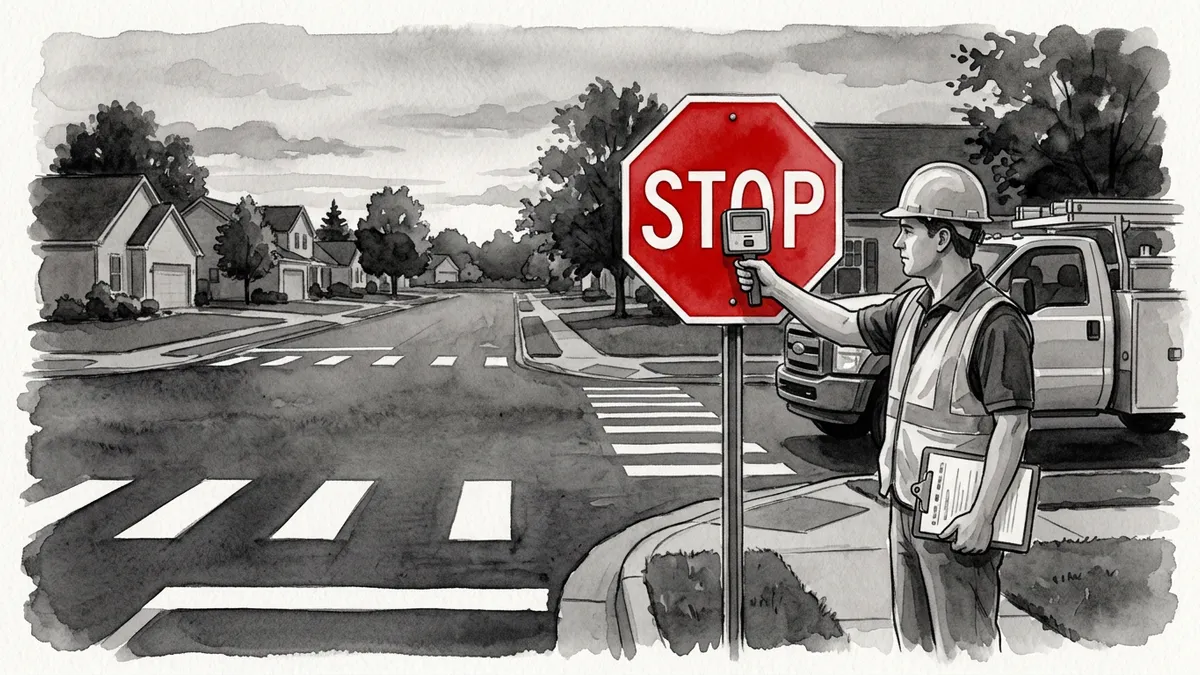
A handheld retroreflectometer is placed against the sign face and reads how much light returns, in candelas per lux per square meter (cd/lx/m²). Table 2A-5 values are measured at a 0.2° observation angle and a –4.0° entrance angle.
Indicators That Signs Need Replacement
When traffic sign visibility is affected, it’s often because of the following:
- Faded colors – red that turns pink, or orange that fades
- Reduced nighttime brightness – when signs don’t reflect enough light
- Damaged reflective surfaces – cracks and peels on the sheeting
- Vandalism – graffiti, dents, or bent signs
- Aging sheeting – when it’s used past its rated lifetime
When signs become difficult to read and hard to see, it’s likely the right time to replace them. Our signs use HIP and FCP sheeting that meets or exceeds the MUTCD minimum retroreflectivity levels when new. For typical lifespans, see How Long Do Traffic Signs Last?
Conclusion
The MUTCD sets minimum retroreflectivity levels for signs while leaving maintenance and inspection processes to local agencies. Regular sign evaluations shouldn’t be limited to the daytime—nighttime retroreflectivity is very important for drivers who travel at night. Shop our Regulatory Signs and Warning Signs, all made with HIP or FCP sheeting. For more on sign colors, see What Do Traffic Sign Colors Mean? and MUTCD Warning Signs Explained.