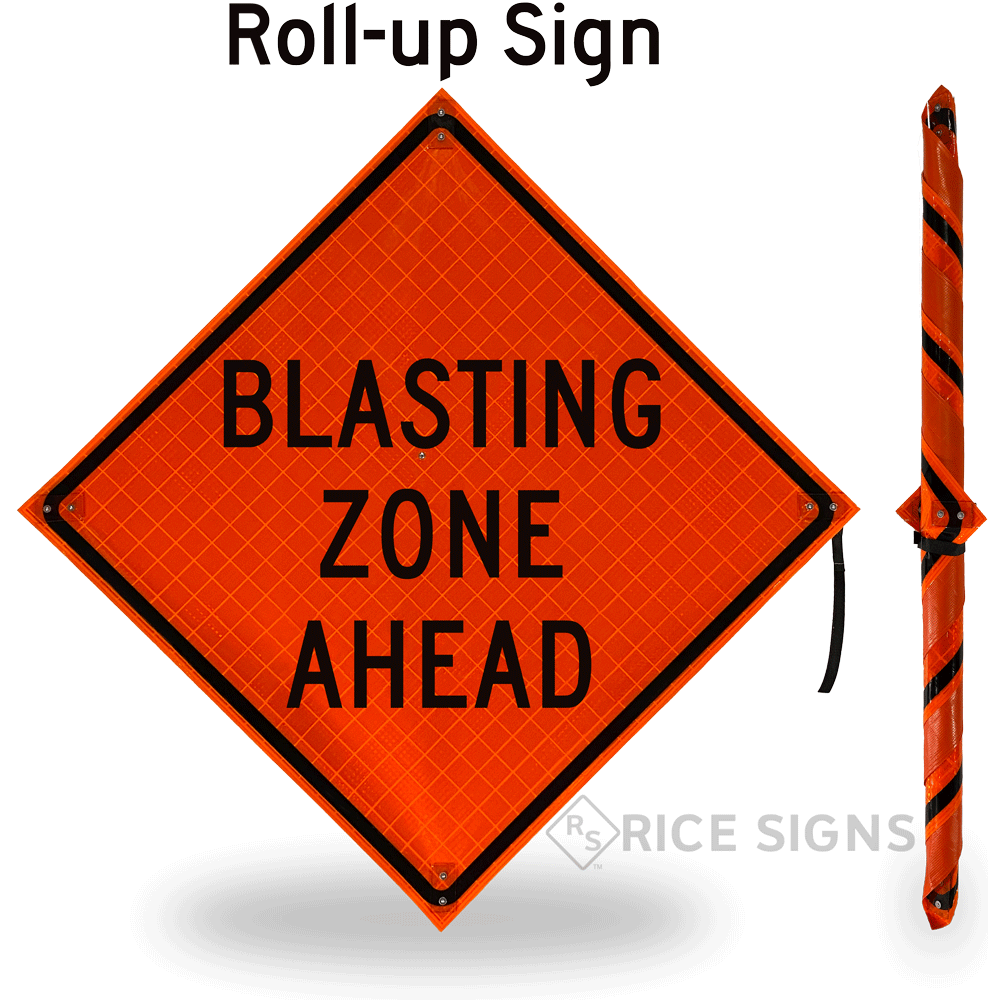
 RU68 Roll-up
 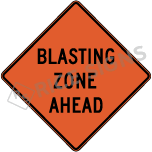 MUTCD W22-1
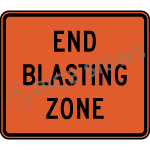 MUTCD W22-3
 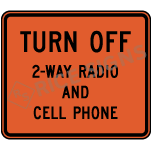 MUTCD W22-2
 MUTCD Blasting Zone Chart
Signs used to warn drivers of active blasting areas in work zones.
| Sign | MUTCD Code | Placement |
|---|---|---|
| Blasting Zone Ahead | W22-1 / RU68 | 1,300–1,500 ft ahead of the blasting zone (300–500 ft ahead of R22-2) |
| Turn Off 2-Way Radio and Cell Phone | R22-2 | Minimum 1,000 ft ahead of the blasting zone |
| End Blasting Zone | W22-3 | At least 1,000 ft after the blasting zone |
About Blasting Zone Signs
What are Blasting Zone Signs?
Blasting Zone Signs warn drivers that nearby blasting operations are underway. The warning helps drivers anticipate the loud sounds of warning signals and detonating explosives.
When are Blasting Zone Signs used?
Contractors source Blasting Zone Signs when explosives are actively being used within 1,000 ft. of the roadway (6P.01, TA-2). When explosives are no longer present at a blasting site, Blasting Zone Signs should be covered or removed (6H.25, 02).
What signs are included in this category?
This category includes diamond-shaped rigid (W22-1) and roll-up (RU68) “Blasting Zone Ahead” Signs, as well as rectangular, rigid “End Blasting Zone” Signs (W22-3).
What are other signs used with Blasting Zone Signs?
Rigid, rectangular “Turn Off 2-Way Radio and Cell Phone” Signs are always used with “Blasting Zone Ahead” Signs. Although the 2009 edition of the MUTCD required the orange W22-2 sign, the latest edition of the MUTCD (2023) does not mention the W22-2 sign. The R22-2 regulatory sign should be used in its place.
Definitions
What is a blasting zone?
A blasting zone is a section of the roadway that lines up with a blasting site. A “Blasting Zone Ahead” Sign marks the start of the zone, and an “End Blasting Zone” Sign marks the end of the zone.
What is a blasting site?
A blasting site, or what the MUTCD calls a “blasting area”, is the location where blasting operations are performed. Every blasting site is bordered by blasting caps, which are a type of electric detonator. The blaster in charge determines whether or not explosives are necessary for the construction project at hand.
What are “blasting operations”?
The operations performed when blasters use explosives for construction work are referred to as “blasting operations”. Blasting operations are highly controlled to minimize danger to workers and drivers alike.
Who is considered a “blaster”?
A blaster is a person authorized to detonate explosives in a work zone. Blasters assess the conditions at hand and are responsible for deciding if a roadway near a blasting site can remain open.
Customizations
Can Blasting Zone Signs be customized?
The MUTCD only mentions “Blasting Zone Ahead” Signs without other distance legends. Local jurisdictions often require additional signs more than 300-500 ft. ahead of the blasting zone. The “Ahead” messaging on both rigid and roll-up “Blasting Zone Ahead” Signs can be modified.
Selecting a Sign
Which sign size should I select?
The sign size required depends on the road type. Table 6H-1 in the MUTCD lists that “Blasting Zone Ahead” Signs should be 36”x36” for most roads, 48”x48” for interstates, and a minimum of 30”x30” in the case that small-scale blasting operations are on a low-speed or residential road. “End Blasting Zone” rigid and roll-up signs should be 42”x36” for most roads, 42”x36” for interstates, and 36”x30” as a minimum.
When should I choose a rigid sign over a roll-up sign, and vice versa?
Rigid signs are generally used for medium- to long-term projects, and roll-up signs are reserved for short-term projects.
Mounting Signs
Where should Blasting Zone Signs be placed?
Signs in this category are placed relative to the blasting zone and to each other. One “Turn Off 2-Way Radio and Cell Phone” Sign (R22-2) is placed a minimum of 1,000 ft. ahead of a blasting zone. Then, a “Blasting Zone Ahead” Sign is placed 300 to 500 ft. ahead of the Turn Off 2-Way Radio and Cell Phone Sign. Finally, an End Blasting Zone Sign is placed at least 1,000 ft. after a blasting zone. (6P.01, TA-2).
What are Blasting Zone Signs commonly mounted onto?
Signs are commonly mounted onto round, square, or U-channel sign posts, or alternatively mounted onto compatible portable sign stands. For rigid signs, 30-inch and 36-inch diamond-shaped signs mount onto one sign post, and 48-inch signs are mounted with two sign posts.
Materials & Shipping
What materials are Blasting Zone Signs manufactured with?
For rigid signs, we layer your choice of high-intensity prismatic sheeting (HIP) or full-cube prismatic sheeting (FCP) onto rustproof .080” aluminum. Blasting Zone Signs with HIP sheeting are orange, and those with FCP sheeting are fluorescent orange. Roll-up signs can be manufactured with one of several reflective and non-reflective materials. All roll-up sign materials are fluorescent orange.
How are Blasting Zone Signs packaged for shipment?
Rigid signs are stacked back-to-back in a flat box, separated by a layer of protective slip sheeting placed on each sign face. Roll-up signs arrive rolled tightly in a box slightly taller than the length of the fiberglass ribs.
Where can I find more information about Blasting Zone Signs?
The Federal MUTCD contains guidance on Blasting Zone Signs. More information on the definitions can be found in Section 56.2 of the Code of Federal Regulations.

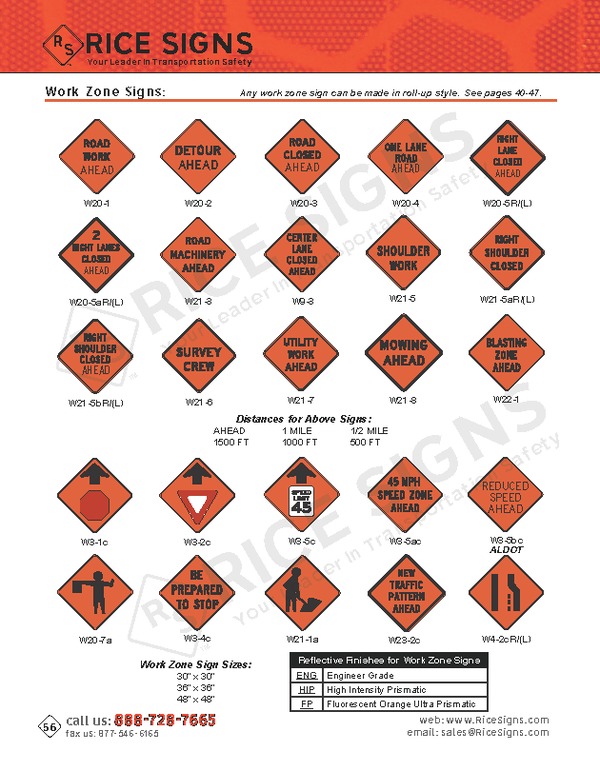
Catalog Page 56
Click to view

