About Merge Signs
What are Merge Signs?
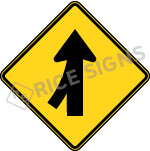
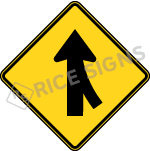
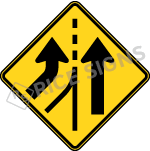
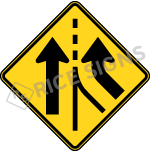
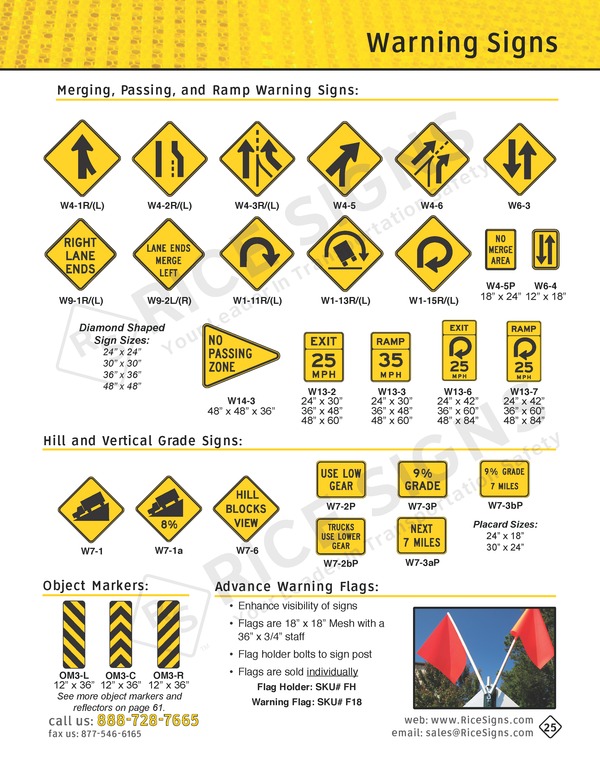
Merge Signs let drivers know that there is an upcoming merging of two lanes or two roads. Each yellow, diamond-shaped sign in this category represents a different merge configuration.
What signs are in this category?
-
When one or more lanes end and merging is needed
- Lane Ends Symbol
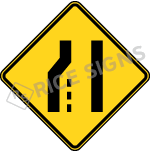 W4-2L
W4-2L 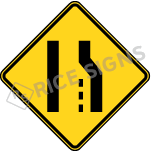 W4-2R
W4-2R
- Left/Right Lane Ends Text
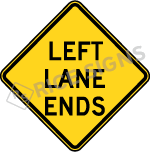 W9-1L
W9-1L 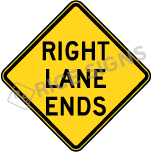 W9-1L
W9-1L
- Lane Ends Merge Left/Right Text
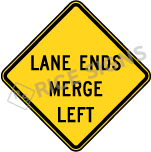 W9-2L
W9-2L 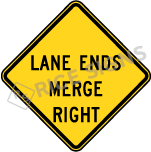 W9-2L
W9-2L
- W4-8 (Lanes Merge Symbol)
- W9-4 (Lanes Merge Text)
- When you merge into a roadway from a ramp or another road
- Entering Roadway Left/Right Symbol
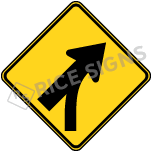 W4-5R
W4-5R 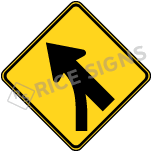 W4-5L
W4-5L
- Entering Roadway Added Lane Left/Right Symbol
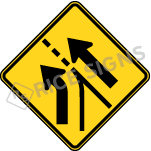 W4-6L
W4-6L 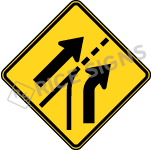 W4-6R
W4-6R
- When other vehicles merge into your travel path
What are some terms I should know?
- Major roadway
- A road that often has higher traffic volume, higher speed, and/or is considered an important travel road. Typically refers to highways and interstates.
- Entering roadway
- The road that merges into a “major roadway.” Includes ramps on interstates and smaller, lower-speed roads.
- Added Lane
- When the entering roadway adds a lane to the major roadway. This addition doesn’t directly interfere with major roadway drivers and their travel way.
- Merge – refers to one of the two following definitions:
- The point where two lanes become one. A typical merge is a result of one lane ending. Drivers must merge to the right or to the left to continue down the roadway.
- The point where an entering roadway of any type leads to a major roadway. Vehicles on the entering roadway either merge into the travel way or stay on a new, added lane.
- “Zipper” merge –
- when two lanes merge into one center lane. Neither lane is considered a “major” roadway or an “entering” roadway.
What other signs are used together with Merge Signs?
Generally, one Merge Sign on each roadway provides drivers enough advance warning. However, other Merge Signs can be used when additional warning is desired.
For instance, when a lane ends on an interstate, an optional assembly of a “Left/Right Lane Ends” Text Sign (W9-1L/R) and a Distance Warning Placard (W16-2P) can be placed ahead of a Lane Ends Symbol Sign (W4-2L/R). This configuration is depicted in Figure 2C-13 in the MUTCD.
In other cases, a symbol Merge Sign is often used with another Merge Sign with a mirrored image. One example is when two curved lanes from the left and right meet in the middle. Both the W4-1L and W4-1R signs are used. Figure 2C-12 in the MUTCD lays out this configuration of signs.
Can I use these Merge Signs in work zones?
The yellow warning signs in this category are designed for permanent installation. For temporary use, orange Work Zone Signs such as the Lane Ends Sign (W4-2CL/W4-2CR) should be used instead.
Are there Merge Placards available?
Yes, the W4-5AP “No Merge Area” Placard is used with a W4-1 Merge Sign or a W4-5 Entering Roadway Merge Sign.
Where are Merge Signs commonly installed?
Merge Signs have a multitude of uses and can be seen at several road configurations. For instance, the Entering Roadway Merge Sign or Entering Roadway Added Lane Sign is typically installed where a ramp leads to an interstate, or where two interstates merge into a combined roadway. In another case, when a lane ending on a local road requires drivers to merge, the Lane Ends Symbol or Text Sign is often used.
Selecting & Mounting Merge Signs
What size sign should I order?
36”x36” Merge Signs are used for typical single- and multi-lane roads, and 48”x48” Merge Signs are used for interstates. For more information, reference Table 2C-1 in the MUTCD.
How are Merge Signs mounted?
Merge Signs can be mounted onto standard round, square, or U-channel sign posts with your choice of sign mounting hardware. 36”x36” diamond-shaped signs have two mounting holes for installation onto one sign post. 48”x48” diamond-shaped signs have four mounting holes and require two sign posts for installation.
Materials & Shipping
What materials are Merge Signs manufactured from?
.080” rustproof aluminum provides the base for each of our Merge Signs. Sheeting is securely adhered to the aluminum. The sheeting used for Merge Signs is your choice of yellow high-intensity prismatic (HIP) or fluorescent yellow full-cube prismatic (FCP) sheeting. HIP sheeting has a 10-year warranty, and FCP sheeting has a 12-year warranty.
When can I expect my order to arrive?
We keep a large stock of Merge Signs ready for quick shipment. Shortly after we ship your order, you will receive an email with UPS tracking information.
How are Merge Signs packaged?
Signs are packaged in cut-to-size cardboard to reduce movement during shipment. To further protect the sign, signs are stacked back-to-back with each sign face covered with slip sheeting.
More Information
Where can I find more information on Merge Signs?
In Chapter 2C
of the MUTCD, reference the following sections for more information:
- 2C.45 – Merge Signs and Plaque
- 2C.46 – Added Lane Signs
- 2C.47 – Lane Ends Signs
- 2C.48 – Lanes Merge Signs
|
|

EXIT
|
|
|
Close
|