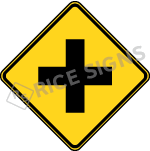
 MUTCD W2-1
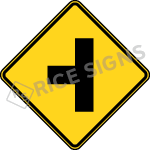 MUTCD W2-2
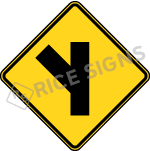 MUTCD W2-3L
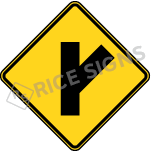 MUTCD W2-3R
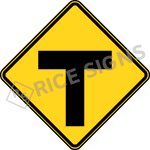 MUTCD W2-4
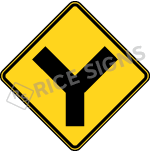 MUTCD W2-5
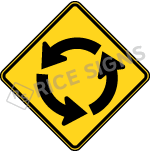 MUTCD W2-6
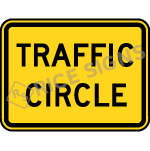 MUTCD W16-12P
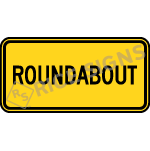 MUTCD W16-17P
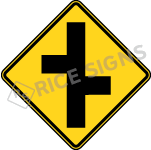 MUTCD W2-7R
 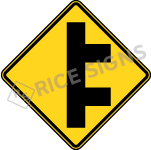 MUTCD W2-7R
 About Intersection Signs
What are Intersection Signs, and where are they commonly seen?
Intersection Signs are yellow diamond-shaped signs used to warn drivers that the traffic ahead will approach from one or more different directions. Intersection Signs are primarily seen on main roads that have relatively higher traffic volume than other nearby roads. These signs are less common in large cities and are more common in rural areas or on low-speed roads.
What signs are included in this category?
Most signs in this category are symbol signs that visually represent the intersection geometry. Some Intersection Symbol Signs show how two roads or three roads intersect, and other signs show the location of one or more side roads relative to the main road.
What are the types of intersections?
Intersection types listed in the MUTCD include the cross road, side road, T-intersection, Y-intersection, and circular intersection (MUTCD Chapter 2C.41, 01-02).
Can Intersection Signs be customized?
Yes, we can modify any sign symbol to better match the geometry of the road. For more information, take a look at the Customizations section down below.
What other signs are used with Intersection Signs?
Yield Signs can be used at circular intersections, commonly known as roundabouts, and Stop Signs can be used at Y-intersections and T-intersections. However, at a cross road intersection or side road intersection, neither Stop Signs, Yield Signs, nor traffic lights can be used (2C.41, 07). The purpose of an Intersection Sign at those intersection types is just to inform drivers that traffic may approach the main road from other directions.
What placards are used with Intersection Signs?
An optional “Traffic Circle” (W16-12P) or “Roundabout” (W16-17P) supplementary placard can be mounted below a Circular Intersection Sign (W2-6) (2C.41, 04). A customizable Advance Street Name Placard (W16-8P or 16-8AP) can be paired with any Intersection Sign (MUTCD 2C.65, 01).
Choosing & Mounting an Intersection Sign
What sign size should I choose for diamond-shaped signs?
For any diamond-shaped Intersection Sign, 30”x30” signs should be used for most conventional roads and 36”x36” signs should be used for an “expressway”, according to the MUTCD (Table 2C-1). The minimum 24”x24” diamond-shaped signs are reserved for low-volume, low-speed local roads, and the oversized 48”x48” signs are used when additional visibility is needed.
What about signs of other shapes?
The W1-7 Double Arrow Sign is available in a 48”x24” size for regular single- or multi-lane roads, and is also available in an oversized 60”x30” size. “Traffic Circle” and “Roundabout” Placards come in one size each, 24”x18” and 24”x12” respectively.
Should I choose the “Traffic Circle” or “Roundabout” supporting placard?
According to the MUTCD, either placard can be optionally used with a Roundabout Sign. State agencies or municipalities often prefer one over the other for jurisdiction-wide consistency in messaging. If used, the placard should be mounted below the Circular Intersection Sign (MUTCD 2C.41, 04).
How are Intersection Signs mounted?
30”x30” and 36”x36” diamond-shaped signs are mounted onto one sign post, and oversized 48”x48” diamond-shaped signs are mounted onto two sign posts. Both size signs of the rectangular Double Arrow Sign mount onto two sign posts. “Traffic Circle” and “Roundabout” Placards mount below diamond-shaped signs. Check out our sign posts and sign mounting hardware pages for the posts (square, round, and u-channel) and hardware needed to securely install your Intersection Sign.
Customizations
When are custom Intersection Signs needed?
Customizations are useful when the geometry of the road is significantly different than the symbol on a standard Intersection Sign. When standard signs sufficiently approximate the intersection geometry, customizations generally aren’t needed.
What customizations are available?
In the past, we have customized the symbol on an Intersection Sign to closely match the geometry of the intersection. For instance, the line representing the left side road on the W2-7R Offset Side Roads Sign can be raised or lowered. In addition, any Intersection Sign can be paired with a customizable Advance Street Name Placard with one (W16-8P) or two (W16-8AP) street names. Contact us via phone or email to start the symbol or street name customization process.
Materials, Ordering & Shipping
What materials are used in manufacturing Intersection Signs?
We use rustproof .080” aluminum as a base for either high-intensity prismatic (HIP) or full-cube prismatic (FCP) sheeting. Choose between yellow HIP or fluorescent yellow FCP sheeting on each product page.
How can I purchase these signs?
Simply navigate to the sign product page, select your material, size, and quantity, and add your selection to your cart. We have a streamlined, easy-to-follow checkout process. Just add your payment information, finalize your cart, and submit your order.
When can I expect my order to arrive?
We keep a large stock ready of standard signs, and we strive to ship our products quickly. Custom signs often need additional processing time. In both cases, you will receive an email with a UPS tracking number once your order has shipped.
More Information
Where can I find more information?
The MUTCD goes into great detail about Intersection Signs in Section 2C.41 of Chapter 2C. Additionally, entry 113 defines what an intersection is in Section 1C.02 of Part 1.

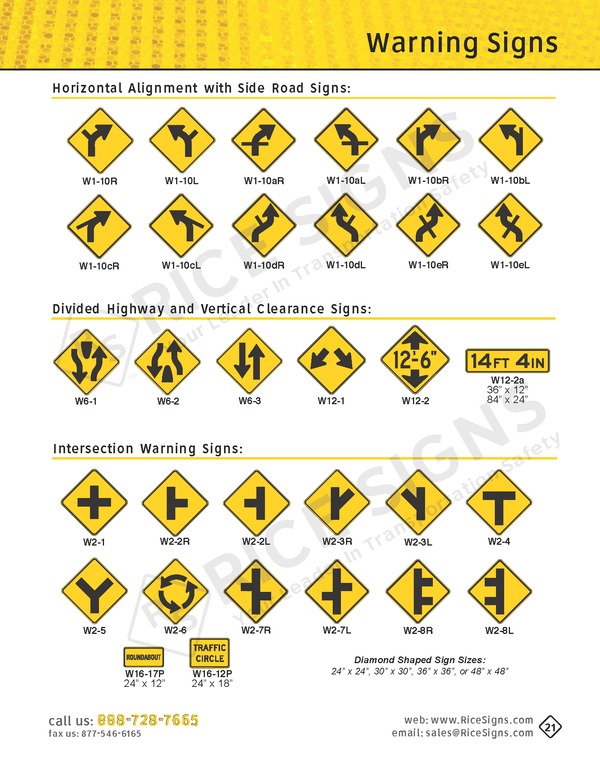
Catalog Page 21
Click to view

